
Puff print vs puff embroidery is not simply a choice between two ways to make a logo look raised. Puff print expands an ink layer during curing, creating a soft, rounded surface. Puff embroidery builds height with foam under dense stitches, creating a more structured edge and visible thread texture. The better option depends on the artwork, garment fabric, placement, intended hand feel, order scope, and the evidence you can approve before bulk production.
For broad graphics and a lighter visual treatment, puff print is often the stronger starting point. For bold lettering, monograms, cap fronts, and designs where a stitched premium look matters, puff embroidery is usually easier to justify. Neither method is automatically more durable or more expensive in every project. Those outcomes depend on the ink system, digitizing, stitch count, fabric support, order quantity, and production controls.
Puff print vs puff embroidery: the quick comparison
| Buyer question | Puff print | Puff embroidery |
|---|---|---|
| What creates the height? | Expandable ink or a puff additive activated during curing | Embroidery foam covered and cut by dense stitches |
| Best visual character | Soft, rounded, slightly organic relief | Defined stitched ridges and crisp satin-stitch edges |
| Artwork tendency | Useful for larger shapes and graphic areas; very small gaps may close | Useful for bold columns and lettering; fine detail needs 3D-specific digitizing |
| Fabric impact | Adds an ink deposit and requires a compatible curing process | Adds stitch density, backing, and local stiffness |
| Typical approvals | Ink formula, mesh/deposit, color, expansion, cure, and washed sample | Digitized file, foam, thread, backing, edge coverage, and washed sample |
| Quotation drivers | Colors, print area, screens, deposit, ink system, and quantity | Stitch count, running time, thread changes, foam, digitizing, and quantity |
How does each raised decoration work?
Puff print expands during controlled curing
A puff screen print uses an ink formulated to expand, or a compatible puff additive mixed into an ink system. The printer deposits the ink through a screen and cures it under controlled conditions. As the expanding component reacts to heat, the deposit rises and rounds over. The result is influenced by the ink system, additive ratio, stencil and mesh choice, deposit thickness, artwork, fabric, and the actual temperature reached by the ink film.
This is why a generic instruction such as “use puff ink” is not an approval standard. For example, International Coatings publishes a puff-additive bulletin with its own mixing guidance and tells printers to determine mesh and cure requirements from the base ink being modified. The relevant process window is product-specific, so the factory should follow the technical data for the chosen system rather than reuse one universal setting. See the manufacturer’s plastisol additives bulletin.
Puff embroidery traps foam under stitches
3D puff embroidery places a purpose-made foam sheet over a hooped garment, then stitches the raised elements through the foam. Dense stitches perforate and cover the foam; excess material is removed after sewing. The design therefore needs a file digitized specifically for the 3D method, not merely a flat embroidery file with extra density added at the machine.
Foam thickness and firmness affect the edge profile, but the artwork and stitch path determine whether ends, corners, and narrow columns close cleanly. Madeira’s technical guidance describes 3 mm foam for raised embroidery on stable fabrics and emphasizes 3D-specific digitizing, foam coverage, and removal. Its 3D foam guide is a useful example of why the embroidery specification must name the actual material and process.
Which technique fits your artwork?
Start with the final-size artwork, not a zoomed-in vector file. Relief consumes visual space. Small counters inside letters, narrow gaps, sharp interior corners, and very thin strokes can fill or distort when an ink deposit expands or when foam must be enclosed by stitches.
- Choose puff print as the first sampling route when the concept uses broad shapes, rounded graphics, tonal effects, or a larger area that should feel integrated with the garment rather than like a badge.
- Choose puff embroidery as the first sampling route when the concept depends on bold lettering, monograms, compact emblems, thread sheen, or a clearly stitched luxury-sportswear character.
- Redraw before sampling when important negative spaces are smaller than the supplier’s proven minimum for the selected process.
- Request two controlled trials when the technique is part of the product concept and the artwork could work either way. Keep garment, placement, dimensions, and color constant so the comparison is meaningful.
Do not approve from a flat mockup. A digital visual can confirm scale and placement, but it cannot show the edge profile, surface texture, local stiffness, shadow, or how a raised element behaves after washing.
How do fabric and garment construction change the choice?
The same artwork can perform differently on a heavyweight hoodie, a lightweight T-shirt, a stretch rib panel, and a structured cap. The decoration supplier should see the production-intent fabric composition, GSM, finish, color, stretch direction, and garment construction before confirming feasibility.
Puff print needs an ink and cure process compatible with the substrate. Heat-sensitive fabrics, dyed polyester, water-repellent finishes, and highly textured surfaces may require a different ink system, a barrier strategy, or a change in placement. Puff embroidery adds concentrated thread and backing. On lightweight or highly elastic fabric, that local structure may pucker, restrict stretch, or feel too rigid. Seam allowances, pockets, zippers, and thick joins can also limit hooping and machine access.
Ask the manufacturer to sample on the production-intent garment, not a convenient substitute blank. If the final fabric changes after approval, reopen the decoration test. You can browse Yinuo Apparel’s customizable apparel references to frame the garment type, then use the OEM and ODM development process to align fabric, construction, and decoration decisions.
What will the customer feel and see?
Puff print usually presents a continuous raised surface. Depending on formulation and deposit, it may look softly rounded, matte, or slightly irregular. Puff embroidery shows individual thread paths and creates a firmer ridge. That stitched structure can communicate craftsmanship, but it also introduces backing, thread sheen, and a different inside feel.
Review each sample from the front, from a low side angle, and from the inside of the garment. Check whether the decoration supports the intended price position and wearing experience. For a large chest graphic, an embroidery route may add more stiffness than the design needs. For a compact cap logo, a puff print may not deliver the defined architectural edge the buyer expects.
Which option costs less?
There is no reliable universal winner. Puff-print quotations can be affected by the number of colors, number of screens, print area, ink deposit, special underbase or barrier requirements, setup, curing, and order quantity. Puff-embroidery quotations are commonly affected by stitch count, machine running time, digitizing, thread changes, foam and backing, trimming, placement difficulty, and quantity.
Compare like for like. Give each supplier the same artwork size, garment, color count, placement, quantity by color and size, sample requirement, wash-review scope, packing, and delivery terms. A low unit price is not comparable if it excludes digitizing, screens, strike-offs, rejected-piece allowance, or a production sample.
How should you approve the sample?
Build the approval around visible and measurable evidence. The first strike-off should answer whether the artwork is feasible; the production-intent garment sample should confirm placement, support, hand feel, and care behavior. Record the exact version of the artwork and decoration specification that the approval covers.
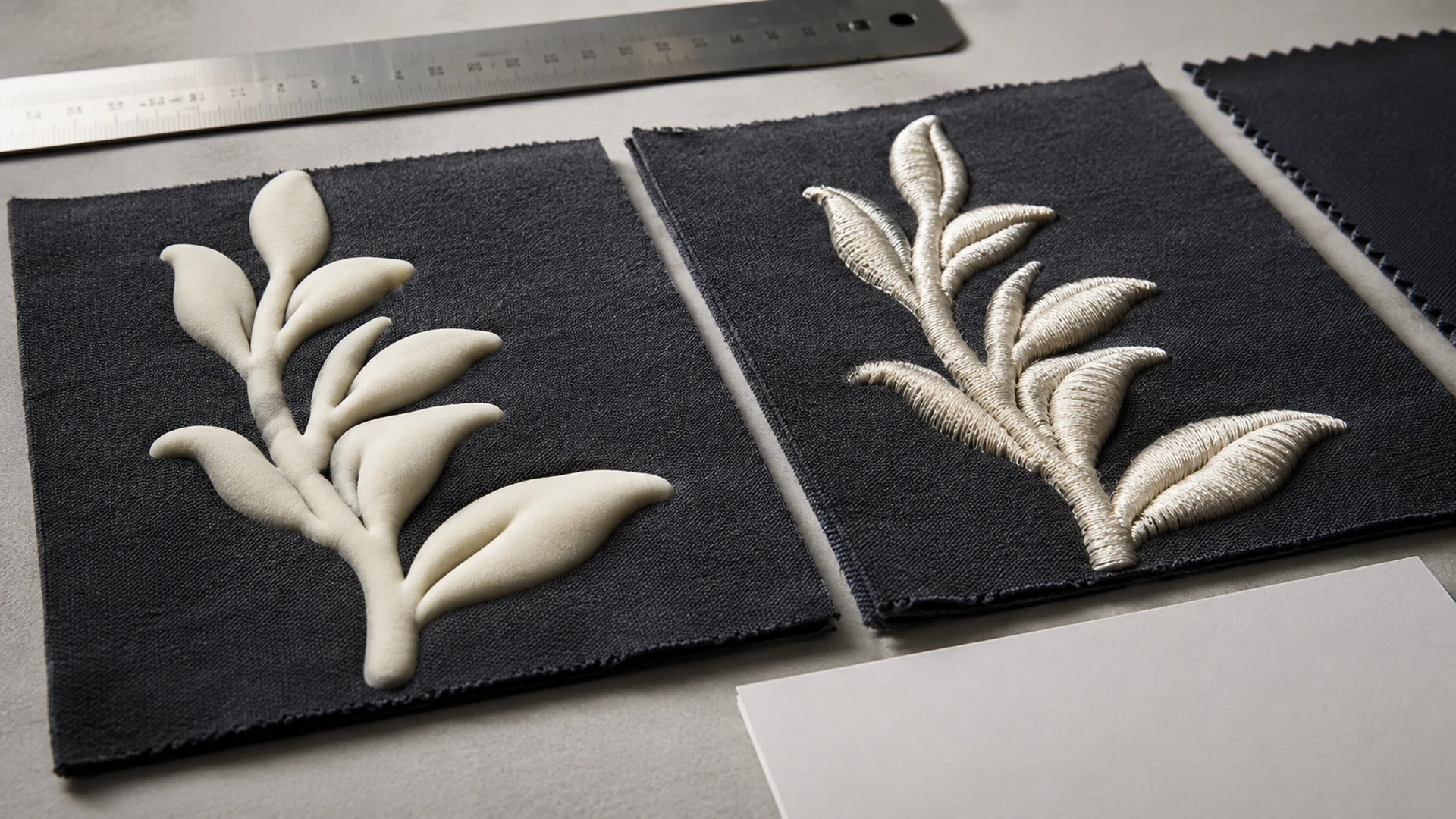
- Confirm scale and placement. Measure the decoration width, height, and distance from agreed garment reference points.
- Inspect height and edge coverage. Look for uneven expansion, closed negative spaces, visible foam, loose edges, or inconsistent relief.
- Check the garment around the decoration. Look for puckering, scorching, dye migration, press marks, restricted stretch, needle damage, or distortion.
- Review color under consistent light. Match ink or thread to the approved standard and note whether texture changes the perceived shade.
- Wash using the intended care method. Compare an unwashed control with the washed sample for cracking, compression, lifting, thread damage, dimensional change, and garment distortion.
- Seal the standard. Keep a signed physical sample, dated photos, artwork version, color reference, process notes, and agreed acceptance points.
Yinuo Apparel’s quality approach explains how sample references and production checks fit into a broader garment approval process. The decoration standard should connect to that process instead of being approved in isolation.
What should the RFQ include?
- Vector artwork and a labeled preview at final physical size
- Garment style, fabric composition, GSM, color, finish, and stretch information
- Decoration position with measurements from agreed reference points
- Preferred technique, desired height, edge character, and hand feel
- Ink or thread color reference and number of decoration colors
- Quantity by garment color and size
- Required strike-off, fit sample, pre-production sample, and approval dates
- Care-label method and required wash-review procedure
- Packing, delivery market, and target in-hand date
- Any open question for which the supplier should quote alternatives
Ask the factory to identify assumptions and exclusions. If it proposes a change to line width, fabric, placement, ink system, foam, thread, backing, or artwork, require an updated sample or written approval before the change enters bulk production.
Can puff print and puff embroidery be combined?
They can appear on the same garment when the design benefits from two distinct textures, but the combination increases development work. Confirm process order, spacing, hoop and platen access, total weight, color interaction, and whether one operation can mark or compress the other. Sample the complete sequence on the finished garment; approving the two techniques separately does not prove they will work together.
Choose the process by approval risk, not by trend
The practical puff print vs puff embroidery decision comes down to the effect your artwork needs and the production variables you can control. Use puff print when a broad, softly raised graphic fits the fabric and ink process. Use puff embroidery when bold stitched structure fits the artwork and garment support. In both cases, approve the final-size artwork on production-intent material, review a washed sample, and preserve a clear bulk standard.
For a feasibility review, send Yinuo Apparel your garment type, fabric direction, artwork, decoration size and placement, quantity by color and size, target market, and delivery window. Those inputs allow a supplier to identify the right sample route and quote the same scope you intend to approve.