
Choosing between garment dye and piece dye is not only a color decision. It changes when color is committed, how seams and trims behave, how shrinkage is approved, and what a buyer should expect from bulk production. The best route depends on the product you want to sell, not on a blanket claim that one method is “better.”
This guide compares garment dye vs piece dye for custom T-shirts, sweatshirts, hoodies, and other cotton-rich apparel. It is written for brands preparing a tech pack, reviewing a sample, or deciding what to ask a manufacturer before placing an order.
Garment dye vs piece dye: the quick answer
Piece dyeing colors the fabric before it is cut and sewn. It is usually the more direct choice when a brand wants a controlled, even color across a production run and is ready to commit fabric yardage to specific colors earlier.
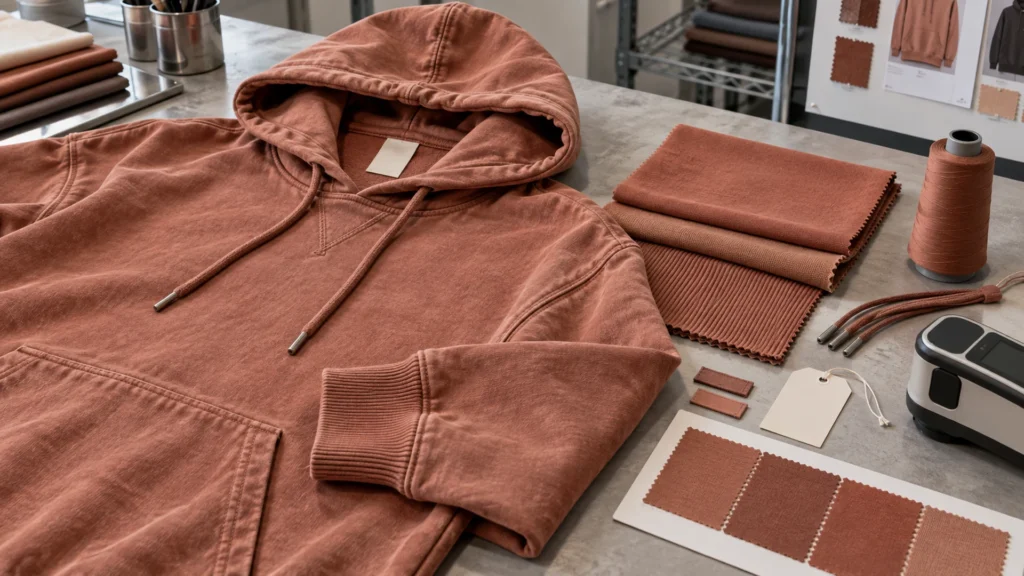
Garment dyeing colors a sewn, dye-ready garment. It can create the softened, lived-in appearance many casualwear and streetwear brands want, including natural variation around seams and edges. It can also delay color allocation until after blank garments are assembled. However, the complete garment—including thread, rib, labels, drawcords, and other components—must be engineered for the dye process.
| Decision point | Garment dye | Piece dye |
|---|---|---|
| When color is applied | After the garment is sewn | Before cutting and sewing |
| Typical visual character | Washed, dimensional, and potentially more varied at seams and edges | Cleaner, more uniform color across the fabric surface |
| Color allocation | Can be decided later if compatible dye-ready blanks are available | Usually committed when fabric lots are dyed |
| Fit and shrinkage approval | Approve the garment after its complete dye and wash cycle | Approve the fabric finish and then verify the finished garment |
| Components | Every component must tolerate and respond correctly to the garment dye process | Trim colors can be sourced to match the approved dyed fabric |
| Best suited to | Washed casualwear, vintage effects, tonal variation | Uniform color programs, cleaner surfaces, planned repeat production |
How the two production routes work
Piece dyeing: dye the fabric, then make the garment
In a conventional piece-dye route, prepared fabric is dyed to an approved standard, finished, inspected, relaxed, and then released for cutting. The factory makes the garment from that colored fabric and adds the specified trims and decoration. Because the bulk fabric is evaluated before cutting, the buyer and mill can address shade, colorfastness, width, weight, and dimensional behavior at the fabric stage.
That does not mean every piece-dyed order is automatically identical. Fabric lots can still differ, and panels cut from mixed lots can produce visible variation. Lot segregation, roll identification, spreading controls, and an agreed shade tolerance remain important.
Garment dyeing: make a dye-ready garment, then add color
For garment dye, the factory first builds a prepared-for-dyeing, often called PFD, garment. The completed pieces are loaded into dyeing equipment, colored, rinsed, washed, and dried according to the approved recipe. Cotton Incorporated’s technical resources include a dedicated bulletin on garment dyeing of cotton apparel, reflecting how specialized this route is.
The sewn shape changes the visual result. Raised seams, pocket edges, ribs, and folded areas move through the bath differently from a flat length of fabric. This helps create depth and character, but it also means the approved standard should be a complete finished garment—not only a loose fabric swatch.
Five factors buyers should approve before choosing
1. Fiber and dye compatibility
Start with the exact fiber composition of the body, rib, thread, and every exposed trim. A cotton-rich body and a synthetic sewing thread may not take the same dye in the same way. A rib with elastane can behave differently from the main fabric. A zipper tape, drawcord, label, or embroidery thread can shift, resist dye, stain, or change hand feel during processing.
Do not approve garment dye based on a fabric description alone. Ask the supplier to identify which components are intended to dye, which are intended to remain contrast, and which require protection or a different construction. Then test the assembled sample through the real bulk-intended process.
2. The color character your brand actually wants
Use piece dye when “correct” means a cleaner, more even surface that stays close to a defined color standard across panels. Use garment dye when controlled variation, softened edges, or a broken-in appearance is part of the design language.
Garment dye variation still needs boundaries. Buyers can approve a target garment plus acceptable lighter and darker limits—a shade band—so production is judged against a practical range. If a brand wants a deliberately faded or pigment-dyed look, document the acceptable seam contrast and surface variation with photos as well as written notes.
3. Shrinkage, measurements, and pattern allowance
Garment dye exposes the sewn item to wet processing, mechanical action, and drying. The supplier must plan the pattern and sewing dimensions so the finished, processed garment—not the undyed blank—meets the approved measurement specification. Body length, chest width, sleeve length, rib recovery, twisting, and seam puckering should all be reviewed after treatment.
Piece-dyed fabric also needs dimensional control. Fabric preparation and finishing affect relaxation and shrinkage before and after sewing. CottonWorks notes that preparation is important to remove impurities and support uniform dyeing; its overview of dyeing preparation is a useful technical reference. For a practical approval framework, see our guide to a garment shrinkage approval standard.
4. Decoration and branding sequence
Printing, embroidery, patches, labels, and transfers must be scheduled around the dye route. Decoration applied before garment dye may change color, become stained, or react to heat and wash chemistry. Decoration applied afterward avoids some of those risks but may sit visually “newer” on a washed garment and adds another production stage.
The right answer depends on the artwork, ink system, thread, adhesive, placement, and intended aesthetic. Ask for a decorated pre-production sample made in the same sequence planned for bulk. If you are developing dimensional graphics, our comparison of puff print and puff embroidery explains additional construction tradeoffs.
5. Reorders and commercial planning
Garment dye can give a brand flexibility to split compatible dye-ready blanks among colors later in the production plan. That can be useful for testing a palette or allocating colors after early sales feedback. It does not automatically guarantee a low minimum order, because dye-house capacity, machine loading, recipe development, and shade control still affect the viable quantity.
Piece dyeing usually requires earlier color commitment because the fabric lot is colored before cutting. In return, it can be easier to build a repeatable fabric program when the material, mill, finish, and approved color data remain controlled. For either route, ask how the supplier will handle a reorder months later: retained standards, recipe records, lot-to-lot tolerance, and availability of the same base material matter more than the process name alone.
A buyer-ready approval workflow
- Define the outcome. Attach a physical reference or clear images and describe whether the goal is uniform color, washed character, seam contrast, or another specific effect.
- Lock the base material. Confirm fiber content, knit or weave, fabric weight, finish, and whether the material is prepared for the chosen dye route.
- Map every component. List body fabric, rib, thread, zipper, drawcord, elastic, label, patch, and decoration. Record the intended response of each during dyeing.
- Approve color at the right stage. For piece dye, review a lab dip and bulk fabric standard. For garment dye, review a complete processed garment with all production components.
- Approve measurements after processing. Measure the sample only after the intended dye, wash, and dry cycle, then compare it with the finished-garment specification.
- Test performance. Agree on relevant colorfastness and dimensional tests, acceptance grades, number of washes, and test method before bulk production.
- Set shade limits. Keep a sealed target standard and, where appropriate, lighter and darker boundary samples.
- Run a pre-production sample. Use bulk-intended fabric, trims, decoration sequence, and process conditions wherever practical.
AATCC lists established methods for properties such as crocking, laundering, perspiration, and dimensional change. The applicable method and pass level should be selected for the product and market rather than assumed. Review the available AATCC test methods, then write the agreed requirements into the purchase specification. Our colorfastness buyer questions can help structure that discussion.
What to put in your RFQ
- Product type, target fit, size range, and order quantity by color
- Fabric construction, fiber composition, target weight, and hand feel
- Requested dye route and desired visual character
- Color reference plus acceptable shade variation
- Complete trim and decoration list
- Finished-garment measurement tolerances and shrinkage requirement
- Colorfastness and care requirements for the destination market
- Required sample stages and approval owners
- Reorder expectations and target delivery window
These details allow a manufacturer to evaluate the actual product instead of quoting from the words “garment dyed” or “piece dyed” alone. You can also review our OEM and ODM apparel manufacturing process and quality-control approach before sending your brief.
Which dye route should you choose?
Choose garment dye when the finished product should look washed, dimensional, and intentionally individual—and when every material and trim can be validated through the full process. Choose piece dye when uniform fabric color, earlier material control, and a cleaner surface are the priority. If the brief combines conflicting goals, a supplier should flag them during development and propose a controlled sample plan.
Planning a custom apparel program? Send Yinuo Apparel your tech pack, target color, order quantity, and reference garment. We can help you compare garment dye vs piece dye against your fabric, trims, decoration, tolerance, and delivery requirements before sampling begins.