
A well-fitting medium does not prove that the XS, XL, or 3XL will work. If the grade rules change every point by the same amount, proportions can drift, openings can become impractical, and design details can move away from the body. Apparel buyers therefore need to approve more than a base-size sample.
This guide explains apparel size grading as a buyer approval process. It shows how to connect the target customer, base pattern, grade-rule table, garment measurements, size-set samples, and wash results before bulk production.
The quick answer: grade rules must preserve fit intent
Apparel size grading is the controlled increase or decrease of a base pattern across a size range. It is not uniform enlargement. Chest, body length, shoulder width, sleeve length, neck opening, armhole depth, pocket position, and other points can require different increments and different distribution between pattern pieces.
Before approving a size set, confirm five things: the intended body population, the approved base size, the increment for every critical point of measure, any breakpoint or block change in extended sizes, and the physical sizes that will be sampled. The output should be a version-controlled grade-rule table plus measured and fit-reviewed garments—not an email saying “grade proportionally.”
| Decision | Buyer should approve | Evidence to retain |
|---|---|---|
| Size architecture | Target market, alpha or numeric sizes, range, and fit position | Body-size strategy and commercial size chart |
| Base size | Reference block, garment specification, and approved fit | Sealed base sample and current base pattern |
| Grade rules | Step between adjacent sizes for each point of measure | Grade-rule table and nested pattern review |
| Extended sizes | Whether one rule set remains suitable or needs a breakpoint/new block | Documented range strategy |
| Size-set coverage | Which sizes must be made, measured, fitted, and washed | Approved size-set samples and reports |
Separate body measurements from garment measurements
A body-size chart describes the person the garment is intended to fit. A garment specification describes the finished product. The difference includes design ease, functional ease, fabric behavior, layering allowance, silhouette, and construction. Mixing the two tables creates avoidable confusion: a 100 cm body chest and a 100 cm garment chest do not describe the same fit.
ISO 8559-1:2017 defines anthropometric measurements used in clothing development. The current ISO 8559-2:2025 establishes primary and secondary dimension indicators for size designation based on body measurements, while garment measurements remain a design and manufacturing decision. ISO 18890:2018 addresses garment measurement points and methods. These standards can align terminology, but they do not supply a universal grade rule for every brand and style.
Keep a separate, clearly named table for each purpose. If your current documents combine them, the distinction in our size chart versus garment measurement guide is a useful starting point.
Eight apparel size grading questions to settle
1. Who is the size range intended to fit?
Start with the target market and fit position, not with familiar labels such as S–XL. Define the sales region, customer group, intended silhouette, layering expectation, and whether the range is unisex or built from a more specific body profile. Alpha labels are commercial names; they do not carry universal dimensions.
If the brand has sales returns, fit feedback, or reliable anthropometric data, use it to challenge the existing chart. ISO 8559-3:2018 describes principles for creating body-measurement tables and intervals from population data. A buyer does not need to reproduce the standard inside a tech pack, but should be able to explain which population and fit promise the range represents.
2. Which size is the development base?
The base size is the pattern and garment from which the range is developed. It should be commercially meaningful and physically approved before grading. Record the block or pattern reference, sample revision, fabric, finish, measurement specification, fit comments, and approval date.
Do not approve the grade while the base fit is still changing. A shoulder adjustment or body-length correction made after grading can require the whole nest to be regenerated and rechecked. The apparel tech pack guide explains how to keep these dependencies in one controlled specification.
3. What is the increment at each point of measure?
A grade-rule table should state the change between adjacent sizes for every controlled point of measure. Do not assume that chest, waist, hip, body length, sleeve length, bicep, cuff, neck width, and pocket dimensions all move by one common value. Also clarify whether a listed increment is the full garment change, a half measurement, or the movement applied to one pattern edge.
Check cumulative change as well as one-size steps. A small mistake can look harmless from M to L but become obvious across XS to 3XL. Ask the pattern team to provide a nested view or a measurement calculation showing the base value, each step, and the final value at both ends of the range.
4. How is growth distributed through the pattern?
The same total chest increase can be distributed differently between front, back, and side seams. Shoulder growth can affect armhole shape; armhole growth can affect sleeve-cap compatibility. A spreadsheet may show the correct finished circumference while the pattern balance, seam lengths, or visual proportions are wrong.
Review the nested pattern at critical joins and landmarks. Check that matching seams remain compatible, notches still align, the grainline is stable, and design lines move intentionally. For oversized products, specify which dimensions create the look instead of simply grading every measurement upward; see the oversized T-shirt fit guide.
5. Do extended sizes need a breakpoint or another block?
Continuing one linear rule across a broad range can create poor proportions at an edge size. The appropriate response may be revised increments, a breakpoint, or a separate block, depending on the target population, style, material, and fit standard. There is no universal size at which that change must occur.
Review edge sizes for more than circumference. Neck opening, shoulder slope, armhole depth, sleeve shape, pocket access, rise, thigh, and garment length can all affect function and appearance. Document any rule change explicitly so the factory does not smooth it away during a later pattern update.
6. Which design details should grade—and which should stay fixed?
Not every component should scale at the same rate as the body. Pocket size and placement, artwork, embroidery, label position, rib width, hood dimensions, drawcord length, zipper length, placket width, and topstitch spacing each need a deliberate rule. Some stay fixed, some change by size, and some need two or more component options across the range.
Use a placement diagram with named reference points. A pocket that moves only from the side seam may drift relative to the center front; an artwork centered on one panel may look too small on the largest size even when its position is mathematically correct. Treat visual balance and measurement control as related but separate approvals.
7. Are grade rules being confused with tolerances or shrinkage?
A grade increment is the intended difference between sizes. A tolerance is the permitted variation around a target garment measurement. Shrinkage is the dimensional change caused by laundering, relaxation, or finishing. Combining these concepts can make an out-of-spec garment appear acceptable or cause the team to compensate for an uncontrolled process inside the grade.
Measure size-set samples under the same defined condition and after the agreed wash process when relevant. If washed dimensions determine approval, identify the wash, dry, conditioning, and measurement sequence. Our garment shrinkage approval guide provides a framework for recording that evidence.
8. Which physical sizes must be reviewed?
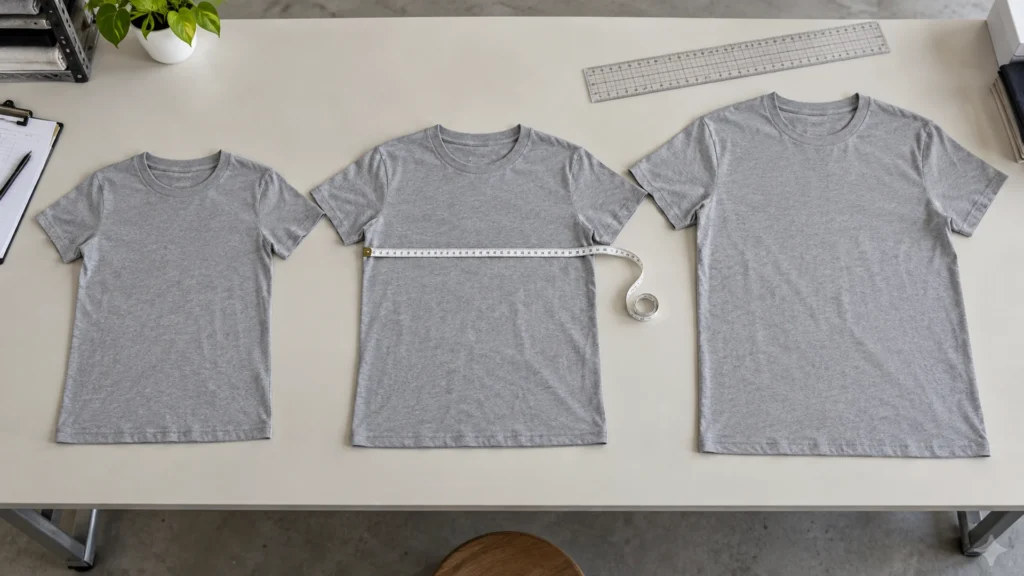
A base-size sample alone cannot verify grading. Making every size may be unnecessary for each development round, but the sample plan should test the range intelligently. A common strategy is to review the base, a smaller size, a larger size, and any size at or beyond a breakpoint. The correct selection depends on range width and product risk.
For each selected size, define whether it will be measured only, fitted, washed, tested for function, or reviewed for artwork and component placement. Record who approved it and whether comments apply to one size or require a rule change across the range.
A practical size-set approval workflow
- Freeze the base-size inputs. Confirm the approved sample, pattern, specification, fabric, construction, and finish revision.
- Approve the size architecture. Record the target customer, labels, range, base size, and any planned breakpoint.
- Review the grade-rule table. Check every critical point of measure, the definition of each increment, and cumulative edge-size values.
- Inspect the pattern nest. Review balance, seam compatibility, notches, grainlines, openings, and design-detail placement.
- Make strategic size-set samples. Use production-intent material and include sizes that test both ends and any rule transition.
- Measure consistently. Follow one point-of-measure method, garment condition, table setup, and reporting format.
- Fit and function-review the selected sizes. Assess silhouette, movement, layering, openings, pocket access, and intended wear.
- Wash and remeasure where required. Compare results with the approved targets rather than changing grade rules to hide process variation.
- Seal the approval set. Retain samples, measurement reports, fit comments, pattern and specification versions, and final buyer approval.
Common warning signs in an apparel grading review
| Warning sign | Why it matters | What to request |
|---|---|---|
| Every POM uses the same increment | Length, circumference, openings, and placements serve different functions | Measurement-specific grade rules |
| No distinction between full and half measurements | The pattern movement may be double or half the intended change | Definitions, diagrams, and worked edge-size values |
| Only the base size is sampled | Proportion and cumulative errors remain invisible | Strategic size-set samples |
| Extended sizes are an automatic continuation | Body shape and product function may not remain balanced | Breakpoint review or alternative block assessment |
| Pockets and artwork have no grading rule | Placement or scale can drift across the range | Size-based placement and component table |
| Grade increments absorb shrinkage or tolerance | Three separate controls become impossible to audit | Separate target, tolerance, and wash-result fields |
| Label size differs across files | Patterns, specs, labels, and packing can be mismatched | One revision-controlled size map |
What to include in the RFQ and tech pack
- Target customer, sales region, fit position, and intended use
- Commercial size labels and complete size range
- Body-size chart kept separate from the garment measurement specification
- Approved base size, block or pattern reference, and sample revision
- Grade increment by point of measure, including full-versus-half measurement definitions
- Breakpoint or extended-size strategy
- Rules for pockets, graphics, labels, rib, hoods, zippers, drawcords, and other components
- Garment measurement diagrams and measurement condition
- Tolerance table kept separate from grade rules
- Wash, dry, conditioning, fit, and function approval requirements
- Sizes required for physical size-set review
- Approval owner and files or samples that become the bulk reference
Yinuo Apparel’s quality approach provides more context for translating approved measurements and construction details into production checks. The most useful RFQ identifies what is fixed, what remains open, and what evidence will close each decision.
Approve the range, not only the middle
Strong apparel size grading keeps the original fit idea recognizable across the commercial range without pretending that every dimension changes in the same way. A buyer should be able to trace each approved size from target body and base sample through the grade-rule table, pattern nest, measured garment, fit review, and wash result.
Preparing a graded apparel program? Send Yinuo Apparel your target market, size range, base-size spec, fabric details, grade table, priority fit points, order quantity, and delivery target. We can identify the open decisions and define a practical size-set sampling route before bulk approval.