
To plan apparel MOQ by color and size, do not divide the style total evenly and assume the result is manufacturable. Build a color-by-size order matrix, then test it against every production minimum that applies: fabric or dye lot, color, artwork, trim, cutting, packing and the total style quantity. The binding constraint—not necessarily the largest number mentioned in the quotation—determines whether the order works.
A supplier may accept 600 pieces for one style but still be unable to produce three custom colors at 200 pieces each if a particular fabric color requires a larger dye batch. Another order may meet the fabric minimum yet create inefficient quantities for separate embroidery artworks or custom zippers. The useful buyer question is therefore not only “What is your MOQ?” but “Which component or process sets each minimum, and at what level does it apply?”
Style MOQ, color MOQ and size MOQ are not the same
The general custom apparel MOQ guide explains why minimum order quantity is not one universal factory number. For color-and-size planning, separate the minimums into operational layers before you build the order.
| MOQ layer | What it may apply to | Buyer evidence to request |
|---|---|---|
| Style total | One garment construction across all approved variants | Total quantity and definition of what can be combined |
| Fabric or dye lot | One fabric quality, knit, finish or custom-dyed color | Minimum in kilograms or metres and estimated garment yield |
| Color | Units sharing the same garment or component color | Per-color quantity and the process that creates the threshold |
| Decoration | One print, embroidery, transfer or placement setup | Minimum per artwork, colorway or application |
| Trim or hardware | Custom rib, zipper, drawcord, label or branded component | Supplier pack size, color minimum and usable surplus policy |
| Cutting or size | Cut bundles, marker plans or very low edge-size quantities | Minimum cut quantity or surcharge logic by size |
| Packaging SKU | Size stickers, barcodes, bags, cartons or retail packs | Minimum per printed component and SKU |
Not every order has every layer. Stock fabric may avoid a custom dye minimum; a shared woven label may serve all colors; a digital decoration route may have a different setup than screen printing. Ask the supplier to identify the actual constraint for the proposed product instead of applying a generic rule from another style.
Build the color-and-size matrix from demand
Start with a demand forecast by sales channel, customer profile and launch purpose. A test order for direct-to-consumer sales may justify a different color mix from a wholesale order with confirmed store allocations. Use historical sell-through when it is available; if it is not, label the ratio as a planning assumption rather than presenting it as proven demand.
- Set the style total. Define the number of sellable units, excluding samples and replacements unless the quotation states otherwise.
- Rank colors by commercial priority. Give the strongest forecast to core colors before adding low-volume options.
- Assign a size curve to each color. Do not assume every color serves the same customer or channel.
- Convert percentages into units. Round deliberately while preserving the color total and the full style total.
- Run the production constraints. Check fabric, decoration, trim, cutting and packaging minimums.
- Compare scenarios. Record what changes in cost, lead time, inventory exposure and approval scope.
The resulting matrix belongs in the same controlled brief as the bill of materials, color references, artwork and measurements. Link it to the current apparel tech pack so a later quantity change does not leave the quotation, label file and packing plan on different versions.
A worked example: 600 units across three colors
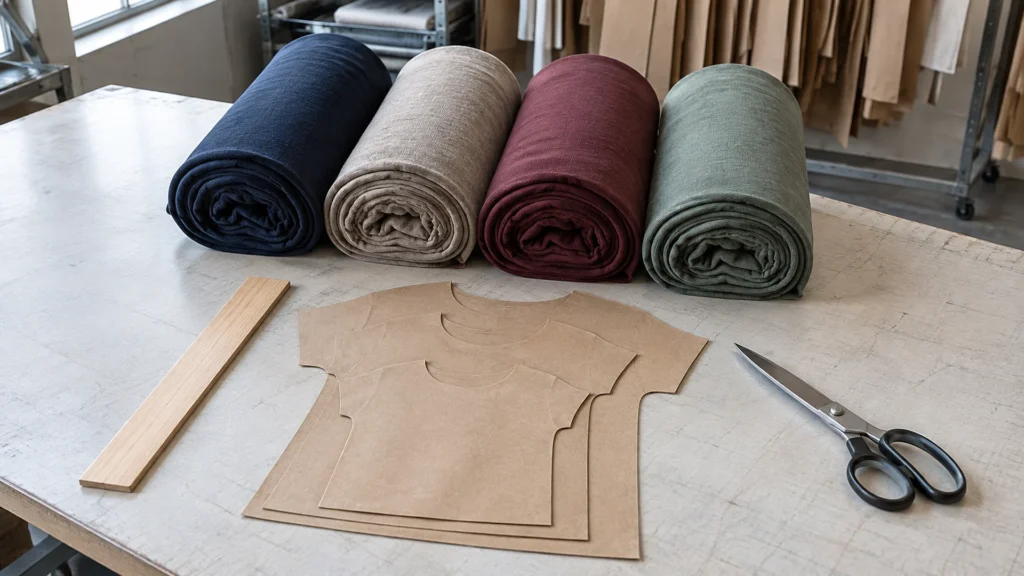
Consider an illustrative 600-piece T-shirt order in Navy, Sand and Berry, offered from XS to XXL. The buyer forecasts a 50% / 30% / 20% color mix and uses one starting size curve. This is an example of the method, not a recommended universal ratio.
| Color | XS | S | M | L | XL | XXL | Total |
|---|---|---|---|---|---|---|---|
| Navy | 15 | 45 | 90 | 90 | 45 | 15 | 300 |
| Sand | 9 | 27 | 54 | 54 | 27 | 9 | 180 |
| Berry | 6 | 18 | 36 | 36 | 18 | 6 | 120 |
| Total | 30 | 90 | 180 | 180 | 90 | 30 | 600 |
The arithmetic balances, but the order is not yet approved. If the proposed custom dye route requires at least 200 garments’ worth of fabric per color, Sand and Berry fall below the threshold. If the Berry color also uses a separate print artwork, its decoration setup must be checked independently. The matrix reveals the problem before fabric is booked.
The buyer can now compare meaningful alternatives: increase Sand and Berry; reduce the order to two colors; move the smaller color to a verified stock fabric; accept a documented small-batch surcharge; or postpone Berry to a later order. Each route changes inventory, cost, shade control or schedule. The supplier should quote the alternatives on the same garment specification so the comparison is valid.
Why fabric often becomes the binding constraint
Fabric may be purchased from stock, knitted to order, dyed from prepared fabric, printed, washed or finished specifically for the style. Each route can create a different minimum and yield. A garment quantity cannot be converted accurately from fabric kilograms or metres without confirming usable width, GSM, marker efficiency, shrinkage, defects, matching components and expected consumption by size.
Ask whether the quoted minimum refers to raw material, one dyed shade, one finished fabric specification or finished garments. Confirm how surplus material is handled and whether it can be retained for repeat production. Before committing to a custom route, use labeled physical references such as those described in the fabric swatch and garment sample comparison; screen color alone cannot approve bulk shade, hand feel or recovery.
Does every size need its own minimum?
Usually, the main minimum is not a completely independent fabric order for every size because sizes can share a fabric color and production setup. However, very low quantities in an edge size may affect marker planning, cutting bundles, sewing balance, labels and packing. Whether that creates a hard minimum, a surcharge or simply an operational preference depends on the factory and product.
Do not remove XS or XXL merely to make a spreadsheet look efficient. First confirm the customer need and ask what specifically makes the quantity difficult. A buyer may choose fewer colors with a complete size range rather than many colors that leave important customers unserved.
Decoration and trims can split one style into several setups
A style may share its pattern and fabric while requiring different print screens, embroidery files, thread colors, transfer sheets or placement setups. Clarify whether the decoration minimum applies per artwork, garment color, print color combination or placement. A tonal logo across three garments may still require different inks or thread shades.
Custom rib, drawcords, zippers, buttons, labels and packaging can create additional thresholds. Identify which components can be standardized without changing the approved product. Sharing a care label or carton specification may be reasonable; substituting a rib color or zipper finish is a visible product change and needs approval.
Five ways to make a smaller order more workable
- Prioritize fewer colors. Concentrate volume where demand is strongest instead of underfunding several variants.
- Use verified stock materials. This can avoid a custom production minimum, but confirm availability, lot continuity and repeat-order risk.
- Standardize hidden components. Share suitable labels, packaging or internal trims when the product specification allows it.
- Choose a compatible decoration route. Compare setup, appearance, durability and repeatability—not only the stated minimum.
- Plan phased releases carefully. A later color drop only helps if material, pricing, shade and production capacity remain available; document those assumptions.
A low unit count can produce a high cost per sellable SKU when sampling, artwork, labels and inspection are spread across too many variants. Evaluate landed inventory and launch risk rather than treating the lowest accepted quantity as the best commercial result.
What to include in an MOQ quotation request
- garment type, construction and current tech-pack revision;
- total quantity and the full color-by-size matrix;
- fabric composition, construction, GSM, finish and stock or custom route;
- color references and which components must match;
- artwork files, decoration method, placement and color variants;
- custom labels, rib, zippers, drawcords, hardware and packaging;
- target market, sales channel and required SKU or barcode structure;
- sample requirements, approval owners and target delivery date; and
- alternative scenarios the supplier should quote separately.
Ask the quotation to state the minimum basis and any surcharge, unused material, component surplus or lead-time effect for each scenario. Keep samples and approval scope consistent when comparing suppliers. The apparel sample approval checklist helps connect the selected quantity route with the physical evidence required before bulk production, while the production lead-time guide shows why late color or ratio changes can move booking and delivery dates.
Common MOQ planning mistakes
| Mistake | Why it fails | Better control |
|---|---|---|
| Dividing the style total evenly | Ignores demand and process-specific minimums | Build the demand matrix first, then test constraints |
| Asking only for pieces per style | Hides fabric, color, artwork and component thresholds | Request the minimum basis by production layer |
| Changing the size ratio after fabric booking | Can alter consumption, labels and packing quantities | Freeze the matrix at a named approval gate |
| Combining unlike artworks as one setup | Understates decoration work and cost | List every artwork, placement and colorway |
| Choosing a stock fabric without continuity checks | Repeat orders may not match or remain available | Confirm lot, shade reference and replenishment route |
| Accepting a low MOQ without total-scope pricing | Surcharges and surplus components may be omitted | Compare full quoted scenarios on the same specification |
Frequently asked questions
Can I combine colors to reach the style MOQ?
Sometimes, but the combined total does not remove a per-color fabric, dye, trim or decoration minimum. Ask which processes can genuinely be shared across colors.
Should every color use the same size ratio?
Only if demand supports it. Different colors may serve different channels or customer groups. Use the best available forecast and keep the total units and production constraints visible.
Is a lower MOQ always more expensive per unit?
It often spreads setup and development costs across fewer units, but the result depends on material route, decoration, labor and component purchasing. Request comparable scenario pricing instead of assuming a fixed relationship.
When should the color-and-size matrix be frozen?
Before material booking and bulk component orders. Later changes should be reviewed for consumption, labels, carton planning, cost and schedule before approval.
Prepare a matrix the factory can assess
A useful apparel MOQ by color and size plan shows the demand decision and every production constraint behind it. For a feasibility review, send Yinuo Apparel your garment specification, total quantity, color-by-size matrix, fabric route, artwork variants, custom components, target market and delivery date. The team can then identify which minimum is binding and compare practical production scenarios on a defined scope.