
Garment measurement tolerances should be set by point of measure (POM), product risk, fabric behavior, construction method and the exact measuring procedure—not copied as one blanket number across a size chart. Before bulk production, the buyer and factory should agree on the target measurement, permitted deviation, garment condition, measuring method, inspection sample and action for an out-of-tolerance result.
This approach turns a tolerance sheet into a production control document. It helps prevent two costly outcomes: rejecting wearable garments for harmless variation, or accepting a size and fit problem because the overall average looked acceptable.
What is a garment measurement tolerance?
A garment measurement tolerance is the permitted difference between a finished garment’s measured value and the approved target for a specific POM. For example, the tolerance belongs to a defined chest, body length or sleeve measurement—not to the garment in general.
A tolerance is not the target specification, a grading increment or an allowance for uncontrolled shrinkage. These terms solve different problems:
| Term | What it controls | Buyer approval evidence |
|---|---|---|
| Target measurement | The intended finished dimension at one POM and size | Approved specification sheet and sample |
| Grade increment | The planned measurement change between sizes | Approved grade rule and size-set review |
| Tolerance | The permitted production deviation from the target | Tolerance table linked to each POM |
| Dimensional change | Change after a defined care or finishing process | Test method, before-and-after results and approval limit |
This distinction matters. Adding a tolerance to a poor grade rule does not fix fit progression, and widening a tolerance does not solve unstable fabric. Buyers should resolve the source of variation instead of using the tolerance column to hide it.
Why should tolerances vary by point of measure?
Different POMs have different consequences and different measurement repeatability. A deviation at chest, waist, rise or body length can change fit. A small difference at a decorative placement may be less critical. Curved seams, elastic openings, rib edges and highly stretchable fabrics can also be harder to measure consistently than a straight woven hem.
The tolerance should therefore reflect both consumer risk and process capability. If the agreed limit is tighter than the factory can repeatedly achieve with the selected fabric and construction, the correct response is to investigate the pattern, cutting, sewing, relaxation or finishing process—not simply to hope the inspection sample passes.
How do buyers set practical garment measurement tolerances?
1. Define every point of measure before assigning a limit
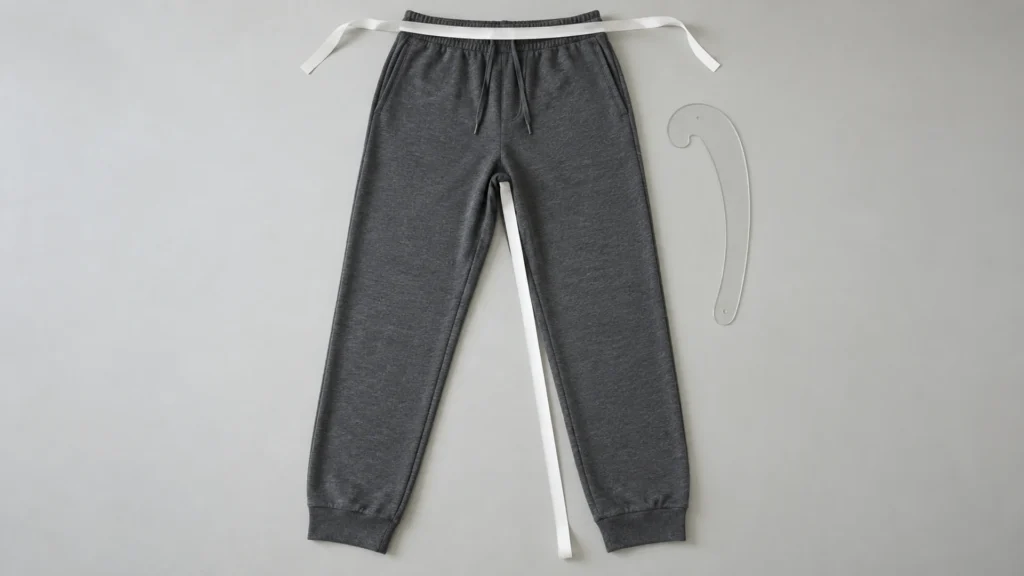
Name the landmarks, measurement direction and garment position. “Chest” is incomplete unless the specification states where below the armhole it is measured, whether the value is half chest or full circumference, and whether the garment is relaxed or gently smoothed. A diagram reduces interpretation differences between the technical designer, sample room, production line and inspector.
ISO 18890:2018 defines main points of measurement and measurement methods for garment products. A brand can use its own method, but the method must remain explicit and consistent across approvals.
2. State the condition in which the garment is measured
Record whether the garment is measured before or after wash, pressing or other finishing; fastened or open; laid flat without tension; and after what relaxation or conditioning period. Define how elastic and stretch panels are handled. If operators measure the same garment under different conditions, the results cannot fairly be compared with one tolerance table.
For dimensional-change testing, ISO 3759:2011 covers preparation, marking and measurement of textile fabrics and garments. Buyers should also connect the measurement plan to an approved garment shrinkage standard.
3. Classify POMs by fit, function and appearance risk
Mark measurements that affect wearability, safety, matching or assembly as critical or major. Typical candidates include chest or waist, neckline opening, rise, sleeve or leg length, paired components and functional openings. Product-specific measurements may be more important than familiar body dimensions: a pocket opening, cuff circumference or hood opening can become critical when it affects intended use.
Do not classify by habit alone. Ask what happens to the customer, downstream operation or retail presentation if the point is outside its limit. That question supports a defensible tolerance priority.
4. Review material, construction and finishing behavior
Assess fabric stretch and recovery, relaxation, shrinkage, seam type, gathering, padding, wash treatment and pressing. A stable woven panel, a brushed knit body and an elasticated waistband may need different controls even within the same style. Review actual development and pre-production sample data rather than assigning numbers only from a generic brand manual.
When a measurement repeatedly drifts in one direction, widening the tolerance symmetrically may conceal a systematic process problem. Check the pattern, marker, spreading tension, cutting accuracy, seam allowance, operator method and finishing recipe first.
5. Decide whether the limit is symmetric
A plus/minus tolerance is convenient, but the acceptable risk may not be equal in both directions. An opening can remain usable when slightly larger but fail when smaller; a maximum safety dimension can have the opposite logic. Use an asymmetric limit only when function, fit or verified production evidence supports it, and show the upper and lower limits clearly.
6. Confirm tolerances across the whole size range
A limit suitable for the base size may not be suitable at the smallest and largest sizes. Check whether the POM, measuring difficulty or functional risk changes across the range. This review belongs in size-set approval, where the buyer can separate a grading problem from normal production variation. See our explanation of body size charts versus garment measurements if those two data sets are being mixed.
7. Define the inspection and escalation rule
State which sizes, colors and quantities will be measured, whether every unit must remain within the individual limit, how paired points are compared, and what triggers an expanded check. Do not rely on an average alone: positive and negative deviations can cancel each other while individual garments still fail.
The approval document should also identify who can authorize sorting, rework, replacement or a written concession. Connect measurement results with the broader garment quality-control inspection plan.
When should measurement tolerances be approved?
Use development to propose the measurement method and provisional limits. Use fit and size-set samples to confirm pattern intent across sizes. Use the pre-production sample to freeze the production-ready specification, including any approved finish or wash condition. During bulk production, compare early measurements with the approved limits before the full quantity is completed.
- Development sample: identify ambiguous POMs and obvious capability risks.
- Fit sample: approve silhouette, balance and target dimensions.
- Size set: verify grade progression and size-specific measurement logic.
- Pre-production sample: freeze the method, condition, targets and tolerances.
- Early bulk: detect systematic drift while correction is still practical.
- Final inspection: apply the agreed sample and escalation rules consistently.
This sequence should be part of the buyer’s sample approval checklist, with dated revisions so that the factory and inspector use the same specification.
What warning signs show that a tolerance plan is weak?
| Warning sign | Why it creates risk | Better control |
|---|---|---|
| One tolerance for every POM | Ignores fit importance and measuring difficulty | Risk-rank and review each POM |
| No measurement diagram | Different operators may use different landmarks | Add diagrams and written methods |
| No garment condition stated | Pressing, washing or stretch changes the result | Define preparation and relaxation |
| Average result used as the only pass rule | Individual failures can disappear in the average | Set unit limits and escalation rules |
| Tolerance widened after repeated failures | May hide pattern or process drift | Investigate root cause and document any change |
| Inspector uses an older specification | Approval evidence becomes inconsistent | Use revision control and one released file |
Buyer checklist before bulk approval
- Each POM has a name, diagram, landmarks and measuring direction.
- Target, upper limit and lower limit are unambiguous for every size.
- Garment condition, fastening, relaxation, wash and finishing state are stated.
- Critical fit and function measurements are identified.
- Tolerances reflect fabric, construction, finish and verified sample evidence.
- Grade rules are approved separately from production tolerances.
- Inspection quantity, size and color coverage are defined.
- Individual failures, averages, paired measurements and recheck rules are clear.
- Responsibility for sorting, rework, concession and final release is assigned.
- The latest revision is shared with production and inspection teams.
Frequently asked questions
Should all garment measurements use the same tolerance?
No. The tolerance should reflect the consequence of failure and the repeatability of the specific POM. Fit-critical, functional and difficult-to-measure points need an explicit review.
Is tolerance added to the size grade rule?
No. A grade rule defines the intended difference between sizes. A tolerance defines acceptable production variation around each approved target. They should be documented and evaluated separately.
Can an acceptable average hide failed garments?
Yes. Oversized and undersized results can offset each other mathematically. The inspection plan should state individual unit limits and what happens when one or more garments fall outside them.
When should tolerances be checked after washing?
Check the washed state when the product is approved or sold on that basis, or when care performance is part of the requirement. Specify the wash procedure, conditioning and measurement method so results are comparable.
Turn the specification into a shared control plan
A useful tolerance sheet connects design intent with measurable factory decisions. It tells every team what to measure, how to measure it, how much variation is acceptable and who acts when a result falls outside the limit. That clarity is more valuable than a long table of numbers without methods or consequences.
Yinuo Apparel can review your tech pack, sample sequence, measurement method and inspection checkpoints before production. Explore our quality process or send us your garment specification for a production-focused assessment.