
Short answer: choose a woven label when the brand mark benefits from a yarn-built texture, a substantial hand and a limited palette. Choose a printed label when the artwork contains very small type, many colors, gradients or dense care information. Neither method is automatically softer, more durable or more premium: the result also depends on the substrate, yarn or ink system, edge finish, fold, placement and the garment’s actual care cycle.
For apparel buyers, the safest decision is made at the final label size and proved on the garment—not on an enlarged screen image. This guide compares woven labels vs printed labels, explains the cost and quality variables behind each option, and provides an approval workflow that can be added to a tech pack.
What is the difference between a woven and printed clothing label?
A woven label forms its ground and design by interlacing yarns. The motif, lettering and background are part of the label structure. A printed label starts with a prepared tape or sheet—often satin-like polyester, nylon, cotton or another specified substrate—and applies the design with a compatible printing process.
This construction difference changes how buyers should approve artwork. A woven design is translated into yarn intersections, so loom density, yarn thickness and color availability affect the result. A printed design is translated through ink, coating and substrate behavior, so resolution, ink holdout, opacity and curing become important. In both cases, the visible result can change when the label is folded, sewn and washed.
| Decision factor | Woven label | Printed label | Evidence to approve |
|---|---|---|---|
| Artwork | Strong for clean logos and shapes that can be resolved with yarn | Strong for fine type, gradients and complex multicolor art | Full-size proof plus physical sample |
| Surface | Yarn-built texture; density can add body | Substrate surface remains visible; print can be very flat | Loose label and sewn garment |
| Color | Selected from available yarn colors or custom development | Mixed or selected through the printer’s ink system | Physical standard under agreed lighting |
| Small information | May lose clarity below the supplier’s workable yarn resolution | Often better suited to dense care or composition copy | Legibility at final size after care testing |
| Hand feel | Depends on yarn, density, backing, fold and edge | Depends on substrate, coating, ink, fold and edge | Skin-contact review in intended placement |
| Durability | Depends on yarn, construction and finishing | Depends on ink-substrate bond and curing | Tested through the intended care cycle |
Which label reproduces artwork more accurately?
Start by reducing the artwork to the proposed finished size. A logo that looks clear at 300% zoom may close up when woven at 35 mm wide. Ask the supplier to flag the minimum workable stroke, gap and character height for the proposed loom construction. If a fine line must be thickened or small letters simplified, approve that change as a controlled artwork revision rather than letting it happen during production.
Printed labels generally give buyers more freedom with fine typography, multiple colors, tonal effects and variable information. That does not remove the need for testing. Fine reverse type may fill in on an absorbent tape; light ink may lack opacity over a dark substrate; and a coating that improves print sharpness may change the hand. Request a physical strike-off on the production substrate.
A practical brand system often uses both: a woven main label for the brand mark and a separate printed label for care, fiber, origin or size information. This allows each construction to do the job it handles best instead of forcing one label to carry every function.
Is a woven label always softer or more durable?
No. “Woven” and “printed” describe how the design is created, not a guaranteed comfort or durability grade. A dense woven label with a stiff backing or exposed heat-cut edge can irritate the neck. A lightweight printed tape may feel soft initially but become firmer if the coating or ink coverage is heavy. The reverse can also be true.
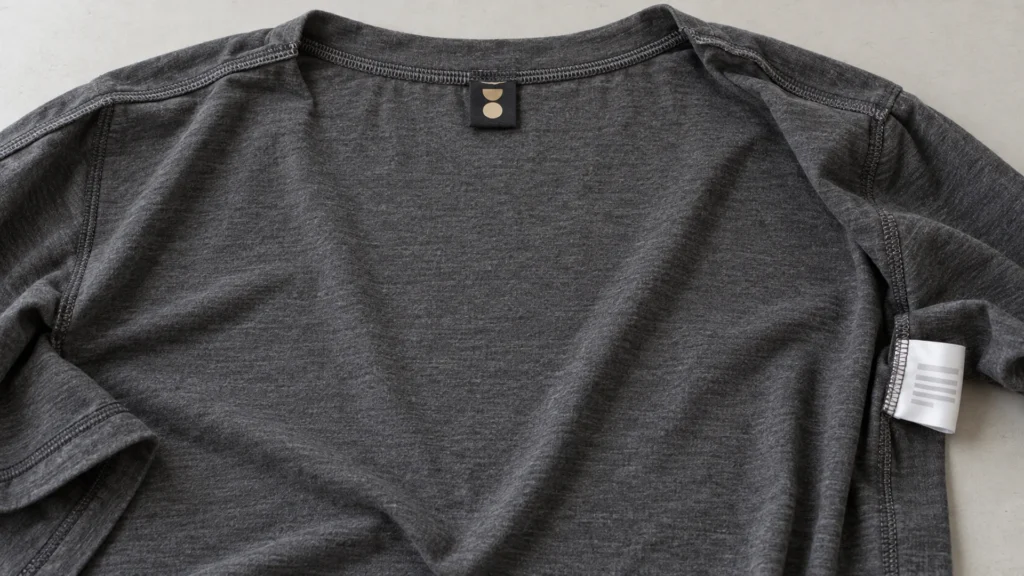
Evaluate comfort in the intended location. Check the face, reverse, fold bulk, corners, cut edges, seam allowance and stitch line. Then sew the label to the actual garment fabric. The same label can feel acceptable on a structured jacket but too firm on a lightweight base-layer knit. A loose sample on a desk cannot reproduce edge pressure, seam tension or movement against skin.
Durability is also system-specific. For woven labels, review yarn colorfastness, abrasion, dimensional stability and fraying control. For printed labels, review ink adhesion, crocking, cracking, migration and legibility after care. Expose the complete garment to the intended washing, drying, ironing or dry-cleaning route. The purpose is not to crown a universal winner; it is to prove that the selected construction remains readable, attached and acceptable for the product’s expected use.
How should label color be approved?
Do not approve label color from a phone photo or an uncalibrated screen. Woven suppliers work with a defined yarn library unless custom-dyed yarn is agreed. Printers work within a specific ink, substrate and curing system. A digital color value may start the discussion, but it does not show yarn sheen, substrate show-through, print opacity or the visual effect of texture.
Send a physical color reference or an agreed color standard, state the viewing condition, and define whether the priority is a visual match to the garment, a corporate color reference or an approved master label. If label and garment colors are meant to blend, review them together after the garment fabric has been dyed and finished. Record the selected yarn or ink reference in the bill of materials and attach the approved physical sample to the style record.
Which fold and edge finish should buyers specify?
Label dimensions are incomplete without the fold and sewing allowance. Common constructions include straight cut, end fold, center fold and loop fold. Each changes the finished visible area and the way force is transferred through the stitching. A 50 mm cut length does not necessarily produce a 50 mm visible label after folding.
- Straight cut: simple and flat, but the edge treatment and stitch position need close review.
- End fold: hides the ends and creates tabs for sewing; specify finished size, fold depth and tolerance.
- Center fold: creates two panels and is useful when information is divided between faces; confirm orientation before sewing.
- Loop fold: forms a loop captured in a seam; specify the total cut length, finished drop and which panel faces the wearer.
Heat or ultrasonic cutting can help seal synthetic edges, but the cut setting can also influence edge feel and discoloration. Woven selvage edges may feel different from cut edges. Ask for a dimensional drawing showing cut size, finished size, fold lines, seam allowance, stitch location and artwork orientation. Put that drawing in the apparel tech pack and verify it again on the fit or pre-production sample.
Does the label method determine legal compliance?
No. A woven or printed construction is a production choice; it does not by itself satisfy the selling market’s labeling rules. Buyers should separate the optional brand label from mandatory information labels, then confirm what information, language, placement, attachment and durability rules apply in every destination market.
For the United States, the Federal Trade Commission states that most textile and wool products need labeling for fiber content, country of origin and the identity of the manufacturer or another responsible business. Its separate Care Labeling Rule requires covered manufacturers and importers to attach supported care instructions to garments. The FTC also notes that required disclosures can appear on one label or separate labels, subject to legibility, placement and access requirements. Review the current FTC textile labeling guidance and Care Labeling Rule guidance; obtain market-specific advice rather than treating this production guide as legal advice.
What drives label cost, MOQ and lead time?
Unit price alone is not a useful comparison unless both suppliers quote the same construction. Label size, number of colors, yarn density, substrate, print coverage, fold, cut, backing, quantity, setup, sampling, testing, individual packing and delivery method can all change the offer. A lower quotation may simply exclude a fold, use a different tape or assume a wider tolerance.
MOQ and lead time can also change when a buyer requests custom-dyed yarn, a nonstandard tape, special metallic effects, very high density or multiple artwork variants. Ask the supplier to identify shared setup costs, the quantity break, sample timing and the point after which artwork or color changes trigger new setup. For a small collection, consolidating label dimensions and limiting avoidable variants can matter more than choosing woven or printed in isolation.
A seven-step clothing label approval workflow
- Freeze the information. Confirm the brand artwork and all required copy before sampling. Assign a revision code.
- Define construction. State woven or printed, substrate or yarn direction, finished size, fold, edge, seam allowance and intended placement.
- Review a full-size proof. Print it at 100% scale. Check line weight, spelling, orientation, hierarchy and the visible area after folding.
- Approve a physical loose sample. Compare color, texture, dimensions, edge finish and legibility with the specification.
- Approve the sewn result. Install it on the production garment fabric and assess appearance, comfort, stitch security and access to required information.
- Run the intended care cycle. Check attachment, color, print or yarn appearance, shrinkage, distortion and legibility. Record the cycle and result.
- Lock the production standard. Keep the approved label with the golden sample, current BOM and signed artwork. Reopen approval if the supplier, material, method or artwork changes.
This sequence can be integrated into a wider apparel sample approval checklist. Where care durability is important, align the label review with the garment’s colorfastness and care-test plan rather than testing the trim in isolation.
Clothing label RFQ checklist
Include the following information so suppliers can quote comparable options and identify feasibility issues before sampling:
- Editable vector artwork plus a reference PDF
- Final visible dimensions and total cut dimensions
- Woven or printed preference, or permission to quote both
- Yarn, substrate, ink, backing and hand-feel requirements
- Color standard and acceptable comparison method
- Fold type, edge finish, seam allowance and stitch method
- Garment placement, base fabric and whether the label contacts skin
- Required label copy, language and destination market
- Garment care method and any test standard or acceptance criteria
- Quantity by artwork, size and color; sample and bulk delivery dates
For broader brand-development decisions, use the private-label apparel branding guide to coordinate labels with packaging, trims and garment specifications.
Frequently asked questions
Can woven and printed labels be used in the same garment?
Yes. A common specification uses a woven main label for brand identity and a printed label for care, fiber, origin, size or traceability information. Approve the placement and attachment of each label.
Are woven labels always more durable than printed labels?
No. Durability depends on the complete construction and care exposure. Compare physical samples after the intended garment care cycle rather than relying on the process name.
Which construction is better for a care label?
Printed labels are often practical for dense, small or multilingual information, but suitability depends on substrate, print system, legibility and care durability. Compliance requirements must be checked for the destination market.
Can label color be approved from a digital mockup?
A mockup can approve layout, but it should not be the final color standard. Approve a physical sample made with the proposed production yarn, ink and substrate under an agreed viewing condition.
Prepare a label brief for sampling
To review label feasibility with Yinuo Apparel, send the editable artwork, finished size, preferred construction, fold, placement, garment fabric, care method, quantity and destination market. If the construction is still open, identify the non-negotiable result—such as fine text, a soft neck feel or a specific brand texture—so woven and printed options can be compared against the same approval standard.