
A golden sample should be managed as a controlled physical reference, not as an unlabeled “good sample” kept somewhere in the factory. Before bulk production, the buyer and manufacturer should identify the sample, define exactly what it approves, link it to the current tech pack and material records, retain matching sealed references, and require written approval for every later deviation.
The garment is useful for judging hand feel, drape, appearance and workmanship, but it cannot carry every requirement by itself. Measurements, tolerances, material identities, artwork files, test methods and packaging instructions still need controlled documents. Golden sample management works only when the physical garment and those records point to one approved product standard.
What is a golden sample in apparel production?
A golden sample is the approved physical garment used as a comparison reference for bulk production and inspection. Depending on the buyer’s terminology, it may be the final pre-production (PP) sample or another sealed reference made after all required corrections are closed.
The name alone has no universal authority. The approval record should say whether the sample controls overall appearance, construction, workmanship, fit, material hand feel, color, decoration, labeling or packing presentation. Anything outside that scope remains governed by the relevant approved document or reference.
What should the golden sample control—and what should stay in documents?
| Approval evidence | Best used to control | Important limitation |
|---|---|---|
| Golden sample | Overall appearance, silhouette, workmanship, drape, hand feel and visible assembly | Can change with handling, age, washing or storage |
| Tech pack and construction specification | Measurements, tolerances, seam methods, placement and product instructions | Must show the same approved revision as the sample tag |
| Bill of materials (BOM), swatches and trim cards | Fabric, color, trim, label and component identity | A garment alone may not identify supplier codes or approved substitutes |
| Artwork, strike-off and embroidery approval | Exact graphic file, scale, color and decoration execution | Color and fine detail may be unreliable in ordinary photos |
| Test and care records | Performance requirements, care method and acceptance evidence | Performance cannot be proven by visual comparison |
| Written deviation or concession | A specifically authorized exception for a defined quantity or lot | Should not silently become the new permanent standard |
Write a precedence rule for conflicts. For example, a dimensional value should normally be resolved against the released measurement specification, not estimated from a sample that may have relaxed. Our guide to garment measurement tolerances explains how targets, grade increments and production variation should remain separate.
How should a golden sample be identified?
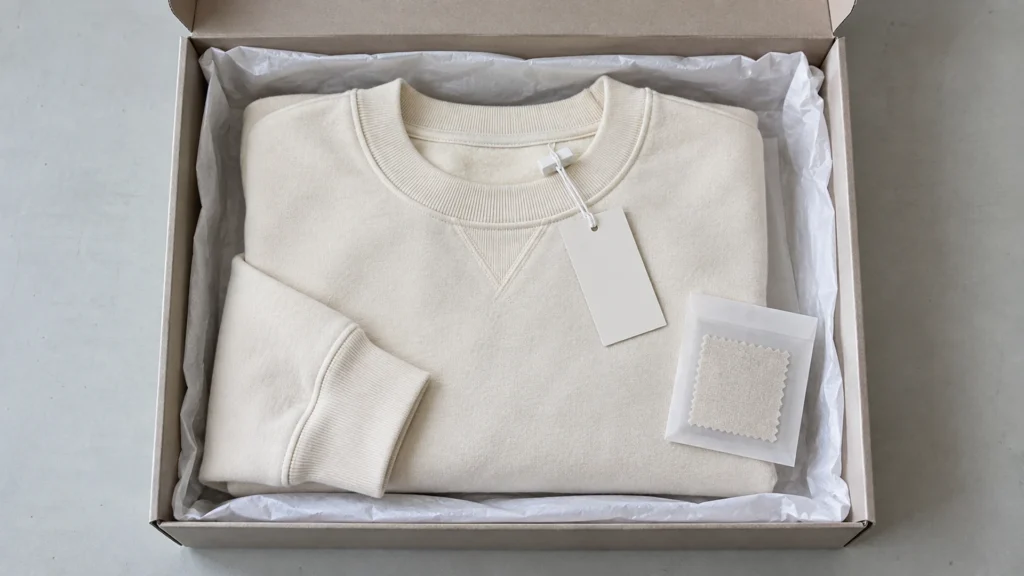
Attach a durable tag or controlled record that makes the sample unambiguous without damaging it. The tag should not rely on a handwritten “approved” note alone. At minimum, record:
- brand or buyer name and supplier name;
- style number and product description;
- sample type, size and colorway;
- unique sample or seal number;
- approval date and named approver;
- tech-pack, pattern and BOM revisions;
- scope of approval and any excluded details;
- open conditions, approved deviations or replacement references;
- location of the matching buyer, factory and inspection copies.
Photograph the sample and its identification tag for the approval record, but treat the photos as identification support rather than a complete replacement. Photography cannot reliably reproduce touch, weight, stretch recovery, subtle surface effects or color under every lighting condition.
This discipline follows the broader quality-management principle that controlled information should be identified, approved, available where needed and protected from unintended change. ISO 9001:2015 is a general quality-management-system standard, not an apparel golden-sample specification; referencing its control principles does not imply that a supplier is certified.
How many golden samples should be retained?
There is no universal number. Retain enough matching references for the people who must make independent production and acceptance decisions. A typical program may need one buyer copy, one factory production copy and one copy available to the inspection team. High-risk products, multiple production sites or long replenishment programs may justify more.
Matching copies should be compared and approved together. Two samples made in different rounds are not equivalent just because both look acceptable. If only one physical reference exists, define who controls it, how it reaches inspections and what happens if it is damaged or unavailable.
How should reference samples be stored and protected?
Store the garment clean, dry and protected from dust, sunlight, moisture, crushing and unauthorized use. Choose hanging or flat storage according to the product: heavy knits can stretch on unsuitable hangers, while structured garments can be distorted by folding. Keep accessories with the sample only when they can be secured without marking or deforming it.
- Seal the reference: use a numbered tag, tamper-evident tie or controlled garment bag.
- Record custody: note the storage location, responsible person and any temporary removal.
- Protect condition: do not wear, wash, alter or use the reference for destructive testing.
- Check periodically: look for fading, yellowing, odor, deformation, print blocking, corrosion or detached trims.
- Set retention: define how long the sample stays active after shipment, repeat order or product discontinuation.
If the physical sample deteriorates, do not quietly replace it. Compare a proposed replacement with the approved documents and surviving references, record the reason, and obtain approval for the new controlled sample.
Where should the golden sample be used during production?
The reference should be available at defined production gates, not locked away until final inspection. Use it to align teams while there is still time to correct drift.
| Production gate | Comparison purpose | Evidence to record |
|---|---|---|
| Pre-production meeting | Confirm all teams use the same sample and document revisions | Meeting record, open issues and release decision |
| First-piece review | Compare early construction, appearance and key measurements before volume builds | Findings, corrections and recheck result |
| Inline inspection | Detect repeated workmanship or appearance drift | Affected operation, quantity and containment action |
| Top-of-production review | Confirm actual early bulk output matches the released standard | Selected sample identity and approval outcome |
| Final inspection | Support consistent visual and workmanship judgment | Inspection report linked to the correct reference |
| Repeat order | Decide whether the earlier standard remains usable | Revalidation, material changes and new approval date |
Use the golden sample alongside the buyer’s garment quality-control inspection plan. The inspector still needs measurable requirements, defect definitions, sample size and acceptance rules; a physical reference does not replace those decisions.
How should post-approval changes be controlled?
Any change that can affect fit, function, appearance, labeling, performance or customer information should enter a written change process. This includes material substitutions, shade changes, adjusted patterns, revised decoration, different sewing methods, new hardware, care-label updates and packing changes.
- Describe the proposed change and why it is needed.
- Identify affected purchase orders, colorways, sizes, quantities and production stages.
- Assess the impact on measurements, appearance, testing, cost and delivery.
- Provide the right evidence: swatch, revised file, sample, test result or comparison photo.
- Obtain approval from the named decision owner before implementation.
- Update the controlled documents and sample tag.
- Remove or clearly mark superseded references so they cannot return to production.
A concession should define its scope and expiry. If a buyer accepts a minor deviation for one shipment, the record should say whether the next order returns to the original standard or requires a formally revised golden sample.
What are common golden sample management failures?
- No version tag: teams cannot prove which sample is authoritative.
- A sales sample used as the production standard: attractive appearance may hide substitute materials or unresolved construction.
- Buyer and factory hold different versions: both may act correctly against conflicting references.
- The sample is treated as the complete specification: numeric and performance requirements become guesswork.
- Bulk changes are approved verbally: later inspectors cannot trace the exception.
- The sample is worn or washed: its measurements, surface and hand feel may no longer represent approval.
- Old samples remain on the line: a superseded version can re-enter production.
- A repeat order assumes nothing changed: material lots, components or processes may require revalidation.
Most of these failures are version-control problems rather than garment-making problems. A strong apparel tech pack and a complete sample approval record reduce the chance that informal comments become the production standard.
Golden sample approval checklist
- The sample type, style, size, color and unique ID are recorded.
- Approval date, approver and decision status are visible.
- Tech-pack, pattern, BOM, artwork and material-reference revisions match.
- The scope of what the sample approves is explicit.
- Unresolved items and approved deviations are attached.
- Buyer, factory and inspector references are matched or traceable.
- Storage method, custodian and retention period are defined.
- Production gates that require the sample are listed.
- Document precedence resolves conflicts with the physical garment.
- Post-approval changes require written authorization.
- Superseded samples and records are withdrawn from use.
- Repeat orders include a revalidation decision.
Frequently asked questions
Is a golden sample the same as a PP sample?
Often, but not always. A final approved PP sample may become the golden sample, while some buyers create or seal a separate production reference after PP corrections. Define the term in the approval record rather than relying on the name.
Can photos replace the physical golden sample?
Not completely. Photos help identify construction and visible appearance, but they cannot reliably reproduce hand feel, drape, stretch, weight or subtle color. Use photography as part of the record, not as the only reference.
What happens when the golden sample conflicts with the tech pack?
Stop and apply the agreed precedence rule. The responsible buyer should resolve the conflict in writing, update the affected document or sample, and confirm which version controls production.
Should a golden sample be reused for repeat orders?
Only after revalidation. Check its condition and confirm whether fabric, trims, pattern, color, decoration, care requirements or the production route have changed. Create a new reference when the old sample no longer represents the repeat order.
Make the approved standard usable
Golden sample management is successful when the right reference reaches the right decision point in a condition that remains trustworthy. The sample, specification and approval trail should tell one consistent story: what was approved, by whom, against which files, for which production scope and how later changes will be controlled.
Yinuo Apparel can review how your physical samples connect to specifications, materials and production checkpoints. Explore our quality approach or send your style number, sample stage, tech-pack revision, material status, order quantity and delivery target for a production-focused review.