
Retail-ready apparel packaging means every sellable unit arrives in the condition, format and data configuration required by its sales channel. The garment should not need emergency refolding, relabeling, retagging or SKU correction before receiving, shelving or fulfillment. For buyers, that requires more than choosing a bag: the specification must control the fold, product protection, labels, barcode data, unit dimensions, pack ratio and approval evidence.
There is no universal “standard retail pack.” A wholesale store, a direct-to-consumer warehouse and a marketplace fulfillment center can require different presentation, identifiers and outer packaging. This buyer checklist shows how to convert the channel requirement into a production-ready packaging specification and how to approve it before bulk packing begins.
What should retail-ready apparel packaging include?
A complete pack specification normally covers five connected layers: the finished garment condition, the folding method, the unit-level packaging, the identification system and the master-carton arrangement. Each layer should identify an owner, a controlled file or physical reference, and an acceptance check.
| Packaging layer | Buyer decision | Approval evidence |
|---|---|---|
| Garment condition | Final pressing, fastenings, inserts and protection of decoration or hardware | Approved finished garment and packing photos |
| Fold and presentation | Fold sequence, visible face, finished dimensions and tag position | Dimensioned fold diagram and packed sample |
| Unit pack | Bag, sleeve, band, box, tissue, closure, ventilation and market-specific warnings | Packaging BOM, artwork and physical sample |
| Identification | SKU, size, color, barcode, price or retailer data and placement | Controlled data file, print proof and scan result |
| Carton interface | Pieces per carton, assortment, orientation, protection and weight or dimension limits | Packing list, carton trial and approved mark layout |
Start with the sales channel, not the packaging material
The same T-shirt may be packed differently for a department-store floor, an e-commerce parcel and a retailer distribution center. Ask the customer, retailer, marketplace or 3PL for its current vendor guide before quotation. Record the document title, revision and date in the tech pack so the factory does not rely on a screenshot or an earlier season’s instructions.
| Channel | Typical priority | Questions to close |
|---|---|---|
| Wholesale retail | Consistent presentation, easy size recognition and store handling | Hanger or folded? Price ticket? Size marker? Display face? Retailer-specific tag position? |
| DTC e-commerce | Product protection, efficient picking and customer unboxing | Does the unit pack enter a shipping mailer? Is the SKU visible without opening? What presentation should the customer see? |
| Marketplace or 3PL | Receiving accuracy, scan reliability and handling compliance | Which identifier, label format, placement, bag closure and carton limits apply to this program? |
| Subscription or gift | Presentation sequence and component completeness | What is the opening order? Which inserts are included? How are sets kept together and checked? |
Treat these as starting questions, not fixed rules. The destination’s current written requirement controls. If the same style serves several channels, create separate packaging variants and SKU-level packing instructions instead of asking one ambiguous specification to cover all orders.
How should the garment fold be specified?
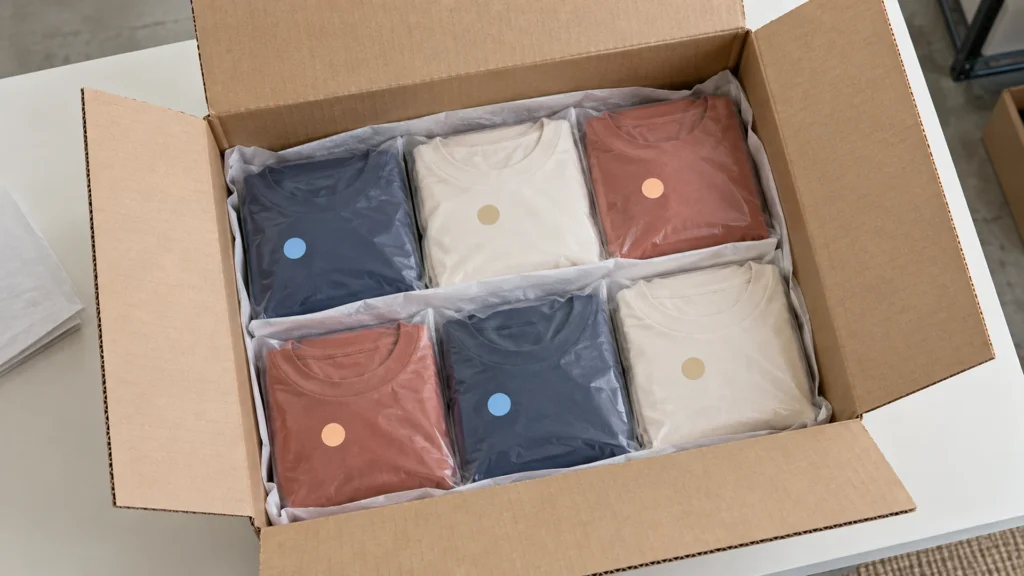
A fold instruction should be repeatable by a packing operator and measurable by an inspector. Show the garment face-up or face-down, the order of sleeve and body folds, any folding board or template, the position of neck labels and decoration, and the finished width, length and thickness. Include a reasonable tolerance where the material’s loft or stretch affects the packed size.
Check what the fold does to the product. A print should not be sharply creased if that can mark the surface. Raised embroidery, hardware, coated fabric or delicate trim may need tissue, a protective sheet or a different fold line. Fasten zippers, snaps or buttons only as specified; an unprotected puller can rub the garment beside it during transport.
Create one approved packed sample and photograph the front, back, side profile and label placement with a scale reference. Link it to the same revision system used for the apparel tech pack. Photos support the instruction, but the physical sample remains useful for judging bulk, hand and presentation.
How do you choose the unit bag, sleeve or band?
Choose unit packaging against the product and channel risks. Define the material, thickness or grade where relevant, dimensions, transparency, closure, ventilation, print, recycled-content claim, warning artwork and acceptable appearance. A generic request for an “eco bag” or “standard polybag” is not enough to compare quotations or control production.
- Protection: Will the pack limit dust, moisture exposure, abrasion, color transfer or snagging for the expected route?
- Visibility: Must the garment color, size sticker or SKU label remain visible without opening the pack?
- Closure: Is the closure resealable, permanent or tamper-evident, and can adhesive contact the garment?
- Ventilation: Does the product or destination require vent holes, and how will their position be controlled?
- Presentation: Will wrinkles, trapped air, excess material or an uneven seal make the pack look unacceptable?
- Recovery route: Are material and disposal claims supported for the selling market and the actual local collection system?
Warnings, language, minimum openings and material-marking rules can vary by destination, product and retailer. The factory should reproduce buyer-approved content, not invent legal wording. Have the responsible compliance team confirm the current requirement before artwork release. Keep substantiation for environmental claims and avoid broad terms such as “green” when the specific basis is not documented.
Who should control apparel barcode and SKU data?
The brand, retailer or authorized data owner should provide the approved identifier and its mapping to style, color and size. The packaging supplier or garment factory may generate print files from that data, but should not guess a GTIN, substitute a size code or reuse an old ticket because the final file arrived late.
GS1 notes that barcode type, size, placement and quality depend on the scanning environment. It also identifies common failure points including insufficient quiet zones, poor contrast, reduced bar height, wrinkles, packaging that blocks the scanner and unsuitable placement. Use the current GS1 barcode implementation guidance and the destination retailer’s specification when preparing the label.
Control the data in a table with one row per sellable SKU. At minimum, include style, color name and code, size, unit identifier, human-readable copy, price or currency when applicable, label version and quantity. Lock the approved file and generate labels from that source. Before bulk printing, compare the label proof with the table, scan a production-representative sample, and check it again after the label is applied to the actual bag or tag.
Placement matters because folds, seals, curved surfaces and secondary stickers can obstruct scanning. Define the distance from fixed pack edges and show the label orientation. Do not place a barcode across a bag seam, closure, wrinkle or carton corner unless the relevant specification explicitly allows it.
What tags and size identifiers belong on the packed unit?
List every component in the packaging BOM: brand hangtag, price ticket, size sticker, promotional card, spare button bag, tissue, belly band or other insert. For each item, specify artwork revision, material, finished dimensions, attachment method, placement and quantity per garment. The private-label apparel branding guide can help align these components with the broader brand system.
Confirm that tags cannot damage the garment or hide required information. A tag pin or string should pass through an approved location; adhesive should not leave residue; and a size marker must agree with the sewn size label. Review the relationship between outer stickers and the garment’s woven or printed labels so the consumer and warehouse do not see conflicting size, fiber, origin or care information.
How should unit packs connect to the carton plan?
The unit pack and carton cannot be approved independently. Folded dimensions determine how many garments fit without crushing, excess movement or an overfilled carton. Run a physical carton trial using production-representative garments and packaging. Record pieces per layer, layer count, orientation, assortment, dividers or liners, void treatment, final carton dimensions and actual gross and net weight.
For solid-size cartons, every unit should match the stated SKU and quantity. For pre-packs or assorted cartons, define the exact size and color ratio and show how the assortment appears on the packing list and carton identification. Reconcile the total units across purchase order, SKU table, packing list and physical count. A neat carton is still wrong if its ratio does not match the receiving record.
Specify carton strength, sealing, marks and destination limits separately rather than assuming the garment factory’s usual carton is acceptable. The next operational document should make carton content traceable without exposing unnecessary consumer-facing information.
Seven approval gates before bulk packing
- Channel requirement confirmed: current retailer, marketplace or 3PL guide is assigned to the order.
- Packaging BOM released: every bag, tag, sticker, tissue, insert and carton component has a controlled specification.
- Artwork and data approved: copy, warnings, SKU mapping and barcode files match the destination and order.
- Packed sample approved: the actual garment is folded, protected and labeled to the intended standard.
- Barcode checked in context: the applied label is readable and scannable on the production-representative surface.
- Carton trial completed: pack ratio, orientation, dimensions, weight and protection are recorded.
- Production standard sealed: the approved pack joins the controlled golden-sample record, and changes require written approval.
Add these gates to the wider sample approval checklist. Final inspection should compare packed units with the approved evidence and sample across styles, sizes and cartons rather than checking only one attractive top layer.
What drives apparel packaging cost and lead time?
Packaging cost changes with material, dimensions, thickness, print colors, special finishes, closure, tooling, artwork count, order quantity, retailer-specific labels, inserts, manual packing steps and testing or verification scope. Freight can also change when the approved fold or carton pack reduces the number of units per cubic meter.
Request quotations against the same packaging BOM and pack ratio. Separate one-time setup charges from recurring unit costs, and identify which components are common across styles. A lower bag price may not produce a lower landed cost if it increases packed volume, causes rework or fails a receiving requirement.
Retail-ready apparel packaging checklist
- Sales channel, destination and current vendor-guide revision
- Garment condition before folding, including fastenings and protective layers
- Fold sequence, display face, finished dimensions and tolerance
- Unit-pack material, grade, dimensions, closure, ventilation and artwork
- Warning and environmental claims approved by the responsible market team
- Hangtag, price ticket, size sticker and insert specifications
- SKU master showing style, color, size, identifier and label version
- Barcode type, size, quiet zone, contrast, placement and scan check
- Pieces per carton, solid or assorted ratio, orientation and protection
- Carton dimensions, gross/net weight limits, strength, sealing and marks
- Approved packed sample, photos and physical carton-trial record
- Inspection method, sample scope, defect handling and change control
Frequently asked questions
Is retail-ready packaging the same for every retailer?
No. Presentation, ticketing, bag, barcode, assortment and carton requirements can vary by retailer, marketplace, warehouse and destination. Obtain the current program-specific guide and record its revision.
Should the garment factory create barcode numbers?
The authorized brand or retailer data owner should supply and approve the identifier-to-SKU mapping. The factory can prepare labels from controlled data and verify the printed result, but should not invent or reuse identifiers.
Can a photo replace an approved packed sample?
Photos are useful for fold sequence and placement, but they do not fully show pack thickness, material hand, closure behavior or how units fit in a carton. Retain a physical reference when those attributes affect acceptance.
When should packaging be approved?
Approve the packaging BOM, data and representative packed sample before bulk components are printed or garments enter the packing line. Late barcode or warning changes can create rework after the product itself is finished.
Prepare a packaging brief for quotation
For a production review, send Yinuo Apparel the product type, sales channel, destination market, order quantity, size and color breakdown, fold dimensions, unit-pack specification, tag and barcode files, carton ratio and delivery target. If a retailer or 3PL guide applies, include its current revision so material, labor, packed volume and approval steps can be quoted against one defined scope.