
Fabric pilling test reports are useful only when the result is tied to an identified material, a named test method and an agreed acceptance requirement. Before approving fabric for a clothing order, check those three links. A statement such as “pilling passed” does not tell a buyer which fabric was tested, under what conditions, or whether the result answers the intended purchasing question.
This guide helps apparel buyers review evidence for T-shirts, sweatshirts and similar knit products. It does not provide laboratory operating instructions or a universal pass grade. The aim is to separate a complete report from an incomplete sales claim, then turn the review into a clear material decision.
Start with the claim you need to verify
Ask whether the report supports initial fabric selection, a revised finish, or release of a particular bulk material. These are different decisions. A development result can help shortlist an option, but the buyer still needs to establish its relationship to the material being purchased.
Keep surface appearance within the wider fabric selection brief. Hand feel, weight and appearance may all matter to the product, but none should silently substitute for the others. Avoid turning “soft,” “heavyweight” or “premium” into an unverified pilling-performance promise.
Do not confuse pills with every surface change
For a buyer’s visual discussion, distinguish diffuse raised surface fibers from small attached tangles of fibers. Record the actual concern instead of describing every change as pilling. A general appearance complaint may need a different investigation from a narrowly defined pilling requirement.
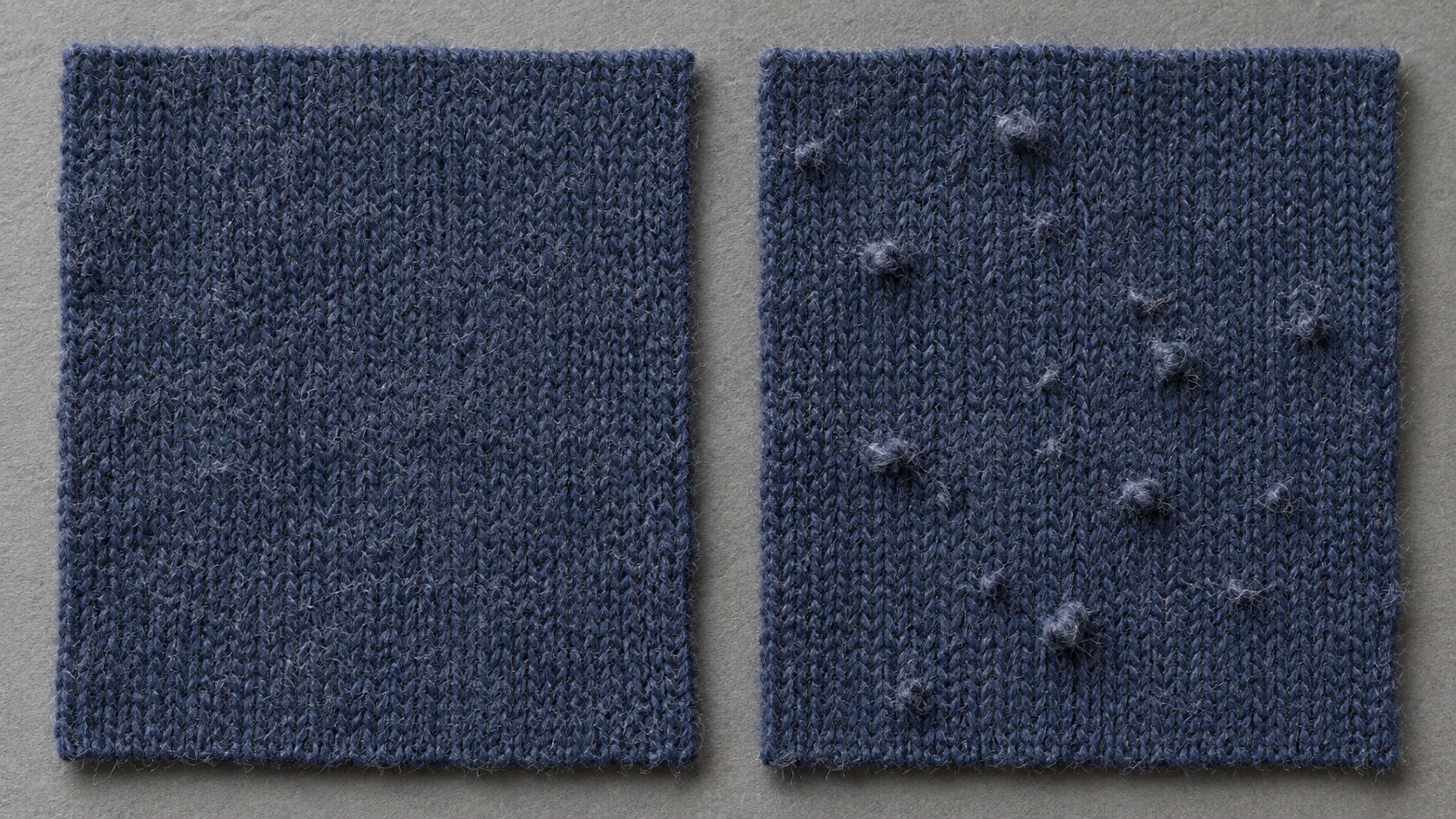
Ask the laboratory what the requested method evaluates and how observations will be reported. If the buyer is concerned about several changes, list each one in the request. A single headline result should not conceal an observation that affects the garment’s intended appearance.
Read the method before comparing the grade
ISO 12945-2:2020 addresses pilling, fuzzing and matting using a modified Martindale method. ASTM D3512/D3512M-22 instead identifies a random-tumble procedure. These names describe different test approaches; do not rank two suppliers from their headline grades without checking that their reports are comparable.
ASTM’s public guidance for D3512/D3512M also cautions against using that method for acceptance testing because of poor between-laboratory precision. If a purchasing specification calls for it, discuss the limitation and any disputed results with the laboratory rather than treating a small difference between laboratories as a definitive supplier ranking.
Request the exact standard designation and edition, the test exposure or assessment stages, and any reported departures from the method. If the buyer has not selected a method, ask a qualified laboratory to recommend an appropriate route for the material and decision. Do not fill in missing conditions from an unrelated report or an internet checklist.
Use this fabric pilling test report checklist
The following is a purchasing review aid, not a replacement for the standard’s reporting requirements. Missing information should trigger a question before release.
| Check | Evidence to request | Question it resolves |
|---|---|---|
| Sample identity | Supplier article, color, construction, finish and submission reference | Is this the material being considered? |
| Production relationship | Development or bulk status, relevant lot identity and sampling record | What purchased material does the evidence cover? |
| Test basis | Method and edition, exposure stages and declared deviations | Was the agreed procedure used? |
| Sample state | As-received or pretreated condition, with any care preparation identified | Are the compared samples in equivalent states? |
| Reported outcome | Applicable grades, observations and assessment references | What did the laboratory actually observe? |
| Acceptance basis | Buyer requirement and decision owner | Does this result meet this order’s requirement? |
| Document integrity | Full report, laboratory identity, date, report number and revision | Can the evidence be checked and traced? |
A screenshot of one result row can omit a qualification elsewhere in the report. Obtain the complete document and ask the issuing laboratory to clarify questionable details through a verified contact route. Keep the original report with the purchase records rather than rewriting its result into an unattributed spreadsheet cell.
Make sample preparation part of the comparison
If one submission was assessed as received and another after a care treatment, flag the difference before comparing them. Ask whether pretreatment was required, which procedure was used, and whether it matches the approved test request. Do not assume that a report date proves the material had already received the intended production finish.
Where wash-related review is part of development, coordinate it with the garment shrinkage approval plan. Keep the decisions separate: a satisfactory dimensional result does not answer a pilling question, and a pilling result does not establish dimensional stability. Each requirement needs its own evidence and acceptance statement.
What should happen after the report arrives?
Use one of three clear dispositions: accepted against the stated requirement, held for missing information, or not accepted with a defined follow-up. Identify the material and scope in the decision. “Approved” on its own can be misread as approval of every color, finish or later delivery.
For example, suppose the report identifies an earlier development finish while the purchase specification names a revised finish. This is a traceability gap, not proof that either version performs badly. Ask the supplier and laboratory whether new testing is needed and document the basis for any reliance on the earlier result.
Put the settled requirement in the apparel tech pack or linked material specification. Retain the relevant reference alongside the golden sample records. If the supplier proposes a substitution, reopen the affected review instead of carrying approval forward because the fabric looks similar.
Does a pass guarantee a pill-free garment?
No. A pass establishes performance against a specified assessment, not every possible wearing condition. ASTM notes that actual-wear pilling is affected by use conditions and individual wearers. Keep marketing claims within the evidence available; a laboratory result should not become an unlimited “never pills” promise.
To discuss fabric pilling test reports with Yinuo Apparel, send the intended garment, fabric reference, finish, proposed care instructions and any existing buyer test requirement. Include the complete report if available and specify whether the decision concerns fabric selection or bulk release. This gives the review a defined question and avoids purchasing on a detached grade.