
An apparel production status report should show what has been completed, what has been accepted, what is blocked and whether the shipment milestone is still achievable. A single percentage cannot answer those questions. Buyers need stage quantities, dated evidence, exceptions, owners and the next decision deadline, all tied to the approved order and specification.
The most useful report is concise enough to review quickly and precise enough to trigger action. It connects the production plan with actual progress, separates finished work from accepted work and explains how each issue affects the next dependent milestone. This guide gives clothing brands and sourcing teams a practical format for that report.
The five questions every status report should answer
A buyer should be able to read one update and find five answers without reconstructing the order from messages and photos.
- What was planned by the reporting date? Show the approved baseline quantity and milestone date.
- What has physically happened? State actual quantities by operation and the date the data was recorded.
- What has passed the agreed control? Keep accepted quantity separate from output awaiting inspection or rework.
- What is blocking the next step? Name the dependency, owner and required decision.
- What does the current position mean for delivery? State whether the shipment milestone is unchanged, at risk or revised, with the basis for that conclusion.
The status date matters. “Sewing 70% complete” has little value if the reader cannot tell whether the figure was measured today, last week or before a stoppage. Use one data cut-off time and one current revision for every section of the report.
Define production status terms before reporting
Factories and buyers may use the same word for different conditions. “Complete” might mean an operation has finished, a supervisor has counted the output or the goods have passed inspection. Agree the definitions before bulk production so the report does not change meaning when pressure increases.
| Status term | Recommended meaning | Evidence to request |
|---|---|---|
| Not started | The operation has no physical output for the stated order line. | Planned start and dependency status |
| Ready to start | Required input, approved reference and capacity are available. | Material or work-order release confirmation |
| In progress | The operation has started; output must be quantified separately. | Actual start date and units completed to the reporting cut-off |
| Completed | The operation has finished the stated quantity, but acceptance may still be pending. | Stage output record or bundle/carton count |
| Accepted | The stated quantity passed the agreed control for moving forward. | Inspection or release record and accepted quantity |
| Blocked | The next work cannot proceed because a named input or decision is missing. | Cause, owner, decision deadline and impact |
Avoid using “on track” as a substitute for evidence. It is a conclusion that should follow from the baseline, actual output, remaining work and known constraints. If the baseline has changed, show the approved revision instead of silently measuring against a new date.
Track quantities by stage, not as one overall percentage
Production is a flow. Fabric can be received while cutting is incomplete; sewing can start while some cut bundles wait; finished garments can remain unaccepted because of rework. Adding those stages into one average percentage can suggest progress that is not available for shipment.
For each style-color-size line, record the planned quantity, quantity started, quantity completed, quantity accepted, quantity in rework and quantity remaining. The definitions must prevent the same unit from being counted twice within one stage. Separate samples, replacements and approved overproduction from the sellable order quantity.
Use the approved color-and-size matrix as the reporting baseline. A style total may look healthy while one color or important size is short, delaying complete assortments for packing or retail allocation.
A worked quantity example
The figures below are illustrative and do not describe a Yinuo Apparel order. They demonstrate why stage totals need context.
| Metric at reporting cut-off | Illustrative quantity | How the buyer should read it |
|---|---|---|
| Order quantity | 1,000 | Baseline sellable units for this example |
| Cut | 1,000 | All planned panels cut; this does not mean finished garments exist |
| Sewn | 780 | Assembly output completed for 780 units |
| Accepted after sewing review | 720 | Sixty sewn units remain outside accepted output |
| In rework | 40 | Named defects are being corrected; disposition for the balance should be stated |
| Packed | 460 | Only these units have reached the packing milestone |
Reporting “78% complete” from sewn output would hide the difference between 780 sewn, 720 accepted and 460 packed units. The buyer also needs the remaining rate and available production time to assess shipment. If the line is producing accepted units more slowly than the plan requires, the exception should be visible before the final packing date.
Match every milestone with evidence
Evidence should confirm the reported status without creating an uncontrolled photo archive. Ask for the minimum useful proof at each milestone, using consistent order references, dates and quantities.
| Milestone | Useful evidence | Control question |
|---|---|---|
| Bulk material received | Receipt record, roll or lot identification and quantity status | Is the received material approved and sufficient for the planned cut? |
| Cutting complete | Cut report by style, color and size; bundle identification | Does the cut quantity reconcile with the order and allowed replacements? |
| Sewing output | Daily or cumulative output with accepted quantity | How much work can move to the next stage without rework? |
| Decoration complete | Quantity by artwork or placement plus approval reference | Were the correct artwork revision, dimensions and colors used? |
| Finishing and inspection | Checked, passed, rework and rejected quantities | Which quantity meets the agreed acceptance controls? |
| Packing complete | Packed units by SKU, carton count and packing-list revision | Do the packed quantities reconcile with sellable accepted goods? |
| Shipment ready | Final release, booking status and required documents | Which remaining action controls handover to the carrier? |
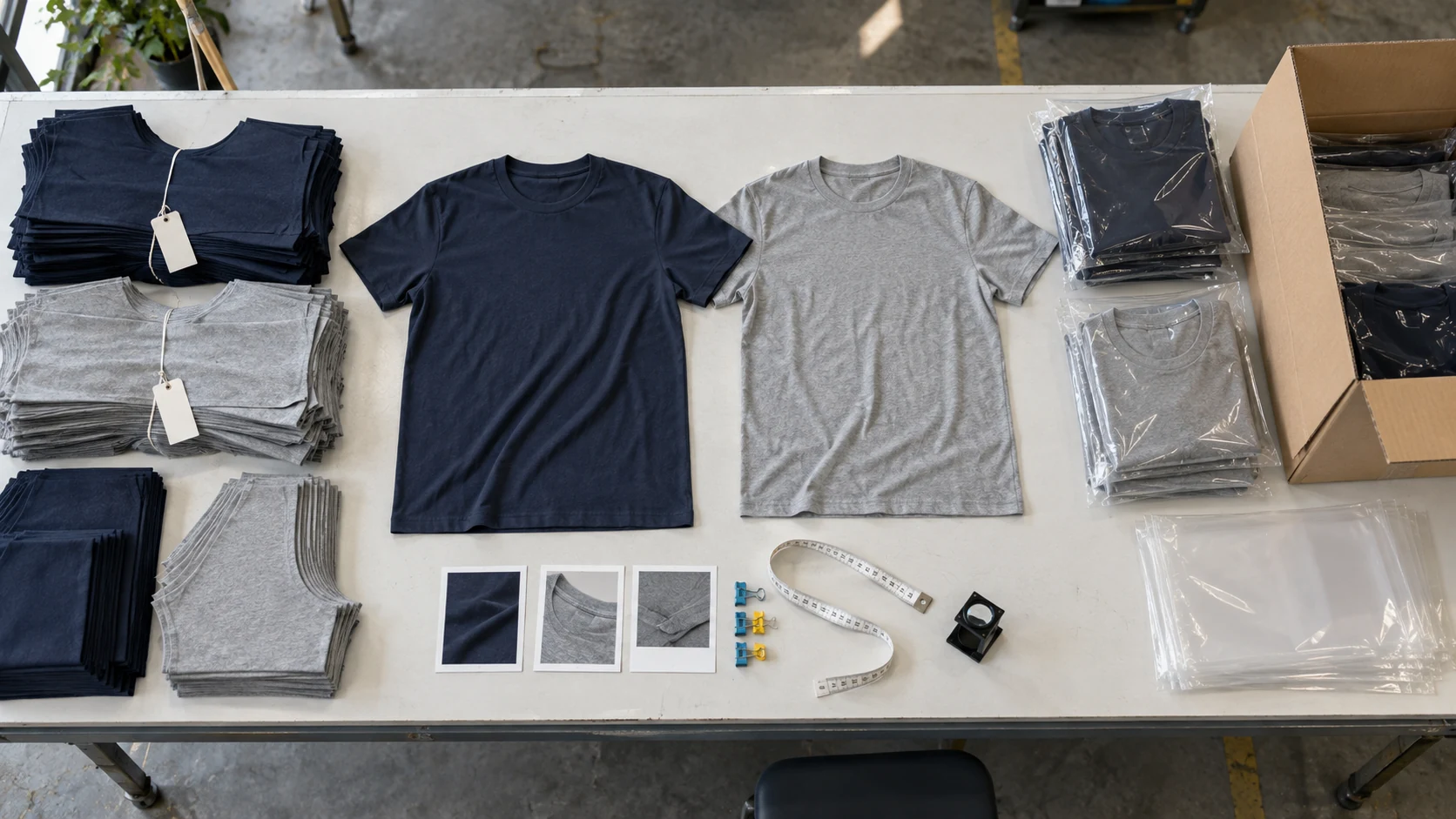
Report variance against an approved baseline
A status report needs a comparison point. Keep the current production baseline visible: order revision, approved quantities, planned stage dates and shipment milestone. When a date changes, record who approved the revision and why. Retain the previous baseline in the history so later reviews can distinguish an original delay from an approved plan change.
For each stage, report planned-to-date quantity, actual accepted quantity and variance. Then explain the cause and downstream effect. The production lead-time plan provides the dependency chain; the status report updates that plan with actual evidence.
Use an exception log for decisions, not a vague risk list
Normal work does not need a long narrative. Give space to exceptions that may change quality, quantity, cost or schedule. Every exception should lead to a decision or monitored recovery action.
| Exception field | What to record |
|---|---|
| Issue | Specific condition, affected style/SKU and quantity |
| Detected | Date, operation and evidence source |
| Requirement | Approved specification or milestone affected |
| Containment | Immediate action that prevents further affected output |
| Owner | Person responsible for the next action |
| Decision deadline | Latest date that protects the current downstream plan |
| Recovery plan | Correction, verification method and revised output expectation |
| Impact | Current effect on accepted quantity and shipment milestone |
Use the defect classification agreed for the order and avoid treating every observation as equal. The garment quality-control guide explains how material, construction, measurement, appearance and packing checks fit into the production flow. When measurements are involved, reference the current measurement tolerances and point-of-measure method.
Choose a reporting cadence that preserves decision time
The right cadence depends on duration, risk and proximity to shipment. A routine weekly update may be enough before production starts, while a material delay, line recovery or final packing period can require more frequent exception updates. Agree the normal reporting day and define which events trigger an update between reports.
More frequent reporting does not create faster production. It can consume time if teams repeatedly rebuild the same spreadsheet. Keep one controlled tracker, update actuals from the same production records and notify the buyer immediately when a decision cannot wait for the next regular report.
Make responsibility visible on both sides
The supplier normally reports factory-controlled milestones, output and corrective actions. The buyer controls decisions such as artwork approval, acceptable substitutions, quantity changes and responses to commercial options. Third-party laboratories, inspection companies, freight forwarders and carriers provide their own dated evidence where their scope applies.
A useful report names the next owner rather than labeling every delay “pending.” If the buyer must approve a replacement trim by a stated date, show that action and its schedule consequence. If the factory must recheck a corrected quantity, show the planned verification and release criteria.
A compact apparel production status report template
A practical report can use one summary row per order or style, followed by stage quantities and an exception table. Include the following fields in a shared spreadsheet or supplier portal.
- Report cut-off date, order number, style and current specification revision.
- Order quantity and breakdown by color and size.
- Current milestone, planned date, actual or forecast date and status definition.
- Planned-to-date, completed, accepted, rework and remaining quantities by stage.
- Material, cutting, sewing, decoration, finishing, inspection and packing status.
- Open exceptions, evidence links, owners and decision deadlines.
- Shipment milestone status and the next update date.
- Name of the person issuing the report and the buyer contact for decisions.
Use attachments selectively. Photos should show the relevant condition, order identity and scale without exposing unrelated customer information. A packing update should reconcile with the controlled carton-mark and packing-list process, rather than relying on uncounted carton photos.
Warning signs in a production update
- All stages display the same percentage or change by the same amount.
- The report shows output but no accepted or rework quantity.
- Actual dates are missing, or the data cut-off changes between sections.
- Photos are undated, cannot be tied to the order or do not show the claimed quantity.
- A shipment date remains “on track” despite an unresolved critical dependency.
- Issues have no owner, verification step or decision deadline.
- The baseline changes without a revision note or buyer approval.
- Packed quantities do not reconcile with accepted goods and the packing list.
Frequently asked questions
How often should a clothing factory send production updates?
Set a regular cadence that leaves time to act before the next dependent milestone. Increase the cadence for a live exception or final shipment preparation, and define which serious changes require immediate notice.
Is a factory photo enough to prove production progress?
A photo can support a specific milestone, but it rarely proves the complete quantity, acceptance status or schedule by itself. Connect it to dated stage records, order references and the relevant inspection or count.
What is the difference between completed and accepted quantity?
Completed quantity has finished the named operation. Accepted quantity has passed the agreed control for moving forward. Keeping both figures prevents rework or unchecked output from being reported as available production.
Should rejected garments remain in the status report?
Yes. Record the affected quantity and disposition, such as rework, replacement, approved concession or rejection, using the agreed process. Do not count those units as accepted or packed unless the required verification has closed.
Request production visibility before bulk work starts
Define the apparel production status report when the order and production plan are confirmed. For a practical reporting review, send Yinuo Apparel your style list, color-size quantities, current specifications, milestone plan, inspection scope, packing requirements, shipment target and decision contacts. The resulting format should make quantities, evidence, exceptions and responsibilities clear before the first bulk update is due.