
Approve print wash durability by testing the actual fabric, artwork and decoration process under a written washing-and-drying plan, then comparing the result with agreed appearance limits. A photograph of a fresh print cannot establish how it will look after laundering. Before releasing custom T-shirts or hoodies, identify the sample, define the care conditions and keep an unwashed reference for comparison.
The useful decision is not simply whether a print is “washable.” It is whether this print remains acceptable on this garment under the care instructions your customer will receive. This guide explains how apparel buyers can turn that question into a documented approval, without confusing a wash procedure with a universal pass standard.
Start with the production combination, not a generic print sample
Ask for a decorated sample made with the intended garment fabric and color, the correct artwork revision and the planned printing process. Record the ink or transfer system and relevant preparation, curing or application settings with the supplier. A smooth transfer on a different blank is useful for an initial discussion, but it does not approve your finished style.
The choice between screen printing, DTG and heat transfer comes before durability approval. Different decoration systems need different production controls. Ask which settings the supplier will verify and how they will connect the tested sample to the bulk-production setup; do not invent one curing temperature for every ink or garment.
Include the difficult parts of your design: broad solid areas, narrow strokes, overlapping colors and edges near seams. Test the approved artwork at its intended dimensions, rather than replacing it with an easier small logo. Keep the print size and placement instructions consistent with the sample submitted for review.
Write the wash-and-dry conditions before testing
A result described as “passed five washes” is incomplete if nobody records the washing program or drying method. Those conditions are part of the evidence, not administrative details. Set the plan before washing, and identify who carries it out and who evaluates the result.
ISO 6330:2021 describes domestic washing and drying procedures for textile testing. Its published summary notes that machine, detergent and dryer parameters can affect results. A report naming this standard should identify the selected procedures; the standard’s name alone does not establish your acceptable level of print cracking or peeling.
| Approval field | What the buyer should record |
|---|---|
| Sample identity | Style, fabric/color, artwork revision, decoration system and sample date |
| Procedure | Named laboratory method and edition, or an explicitly documented internal screening procedure |
| Washing conditions | Selected program, temperature, detergent, load and garment orientation |
| Drying conditions | Selected drying procedure and settings; no unrecorded substitutions |
| Exposure and review | Agreed number of complete wash-and-dry cycles and intermediate review points |
| Acceptance evidence | Retained reference, agreed defect descriptions, viewing conditions and reviewer |
This is an approval-record template, not a laboratory test method. Have the laboratory select and perform the appropriate procedure when a customer specification or formal report requires it. A supplier’s informal wash check should be labelled as screening, not presented as accredited testing.
Separate cracking, peeling and color change
Review each defect separately after the agreed drying stage. Cracking means breaks in the printed surface; peeling means a printed or transferred layer lifts away from the fabric. Fading is a change in color appearance. One sample may show more than one issue, and “print damaged” is too vague to guide a correction.
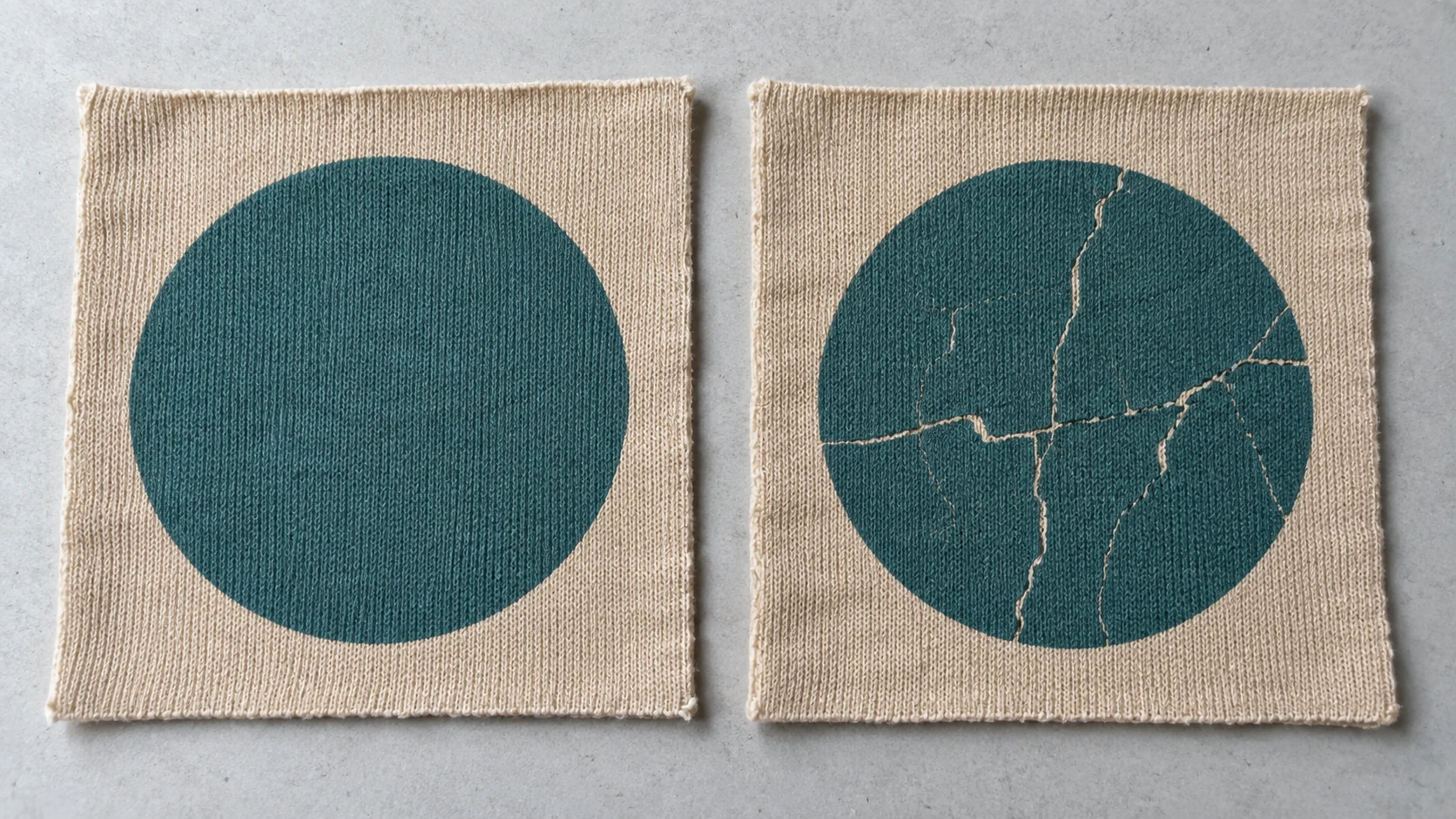
Agree what is unacceptable in the areas that matter to the design. For example, the parties could reject any edge lifting on a transfer and use retained physical references to define acceptable color or surface change. Those are negotiated project criteria, not universal industry limits. If the graphic intentionally has a distressed finish, document its original gaps so later damage is not mistaken for the approved design.
Photograph the whole graphic and close-ups of the same areas under consistent lighting. Keep the unwashed control out of the wash and avoid relying on a phone image alone for a borderline decision. A separate color-fastness review may be needed when the concern is color change or staining, rather than loss of adhesion.
Check the garment around the print
Record changes in the garment as well as the decoration. If the body becomes shorter or the panel twists, an intact graphic can still look different when worn. Compare print appearance in the relaxed garment state and review the surrounding shape, rather than stretching the fabric to hide or exaggerate cracks.
Keep garment shrinkage approval as a separate recorded decision. A print-durability pass does not automatically mean the size, fit or seam appearance has passed. Likewise, a dimensional problem does not by itself prove that the ink or transfer failed.
Make the care instructions match the tested promise
The intended care label should be an input to approval, not an afterthought. As one process-specific example, Printful’s DTG care guidance recommends cold, gentle washing inside-out and hanging or low-heat drying. That is guidance for its products, not a substitute for instructions validated for your own fabric and printing system.
If your retail promise allows tumble drying but the sample was only line dried, ask for a review under the intended drying conditions before approval. Do not claim a fixed service life from a limited wash check. Agree cycle counts according to the product brief and customer requirements; no single count makes every printed garment durable.
Document print wash durability before bulk release
Use an approval record linking the tested sample, procedure, observations, photographs and decision. Keep the unwashed reference and reviewed sample within your golden-sample management system, but distinguish their roles: one shows the original appearance, while the other records the appearance after the stated exposure.
If the result is rejected, record the correction and review a new sample instead of silently changing the pass criteria. Reassess whether approval still applies when the fabric color, artwork, ink, transfer material or production settings change. A supplier can propose a correction, but the buyer should explicitly approve the revised evidence before release.
For a useful print wash durability discussion, send Yinuo Apparel your garment specification, artwork dimensions, proposed decoration method, intended care instructions and customer acceptance requirements. Ask the team to confirm which sample and verification steps are available for the project before you approve production.