
Hoodie trim approval should cover both the individual component and its performance after attachment to the garment. Identify the drawcord, zipper, eyelet and other hardware by specification and reference, then review the assembled sample for operation, attachment, appearance and compatibility with the intended care process. A good-looking trim card alone does not establish that the finished hoodie is ready for production.
This guide is for buyers developing adult hoodies and sweatshirts. It provides a practical approval workflow, not universal test limits or a compliance certificate. Children’s styles need a separate market-specific safety review before adopting an adult design, particularly where cords or detachable components are involved.
Start with the wearer, market and garment construction
Before choosing a finish or shape, define the intended wearer, sales market, garment type and care method. Confirm whether the hoodie is a pullover or full-zip style, whether a cord is functional or decorative, and where each component sits. A part that works on a thick reinforced panel may behave differently on a lighter stretch fabric.
Record component codes and variant mapping in the apparel bill of materials. Link each row to the current supplier specification and approval reference. Do not let a generic description such as “silver zipper” become the entire purchasing instruction.
What belongs in a hoodie trim approval record?
| Component | Define before sampling | Check on the assembled garment |
|---|---|---|
| Drawcord | Material, construction, width or diameter, length basis, color, ends and routing | Movement through channel, visible length, retention, end condition and appearance after agreed care |
| Zipper | Supplier item, chain type and size, length, opening configuration, slider, puller, tape and finish | Opening and closing, alignment, fabric clearance, end installation and appearance |
| Eyelet or grommet | Material, dimensions, finish, backing parts and setting specification | Edge condition, seating, reinforcement, rotation or loosening and contact with cord |
| Tips, snaps and other hardware | Part reference, dimensions, finish, compatible mating parts and attachment method | Security of attachment, operation, exposed edges and contact with fabric or skin |
Add the style, colorway, size range, sample identifier, review date and decision owner. For a measured requirement, state the method, units, conditioning and acceptance criteria. If these are still open, ask the relevant supplier or laboratory to define an appropriate proposal; do not invent one force or cycle count for every hoodie.
Drawcord approval: define length and routing together
Distinguish the total cut length from the exposed length after installation. Record the garment condition used for measurement and how the cord is positioned. Otherwise, two people can report different values while measuring the same sample. Include the intended end treatment and any retention construction in the drawing, not only in a photograph.
Review the cord with the actual channel and eyelet arrangement. Look for snagging, fraying, uneven projection and difficult adjustment. After the agreed care process, compare color, surface condition and end attachment with the original reference. A loose cord sample can help select appearance, but it cannot confirm the assembled routing.
Do not copy adult hood cords into children’s outerwear
For the United States, CPSC guidance on children’s upper outerwear identifies hood and neck drawstrings in sizes 2T–12, or equivalent, as a substantial product hazard. It also sets out separate restrictions for waist and bottom drawstrings in sizes 2T–16, or equivalent. This is not a complete children’s garment compliance review. Confirm the actual classification and applicable market requirements with a qualified compliance specialist before design release.
Zipper approval: review the complete assembly
For a full-zip hoodie, specify the required separating configuration rather than assuming it from chain color or appearance. Confirm whether one-way or two-way operation is intended, the slider and puller combination, and any locking function. Define the length measurement convention and the size-to-length mapping with the supplier.
Operate the installed zipper through its full intended travel. Check that surrounding fabric, seam allowances or a guard do not enter the slider path. Review bottom engagement, top-end placement, left–right alignment and the way the front hangs when closed. Evaluate a wavy front as an assembly issue to investigate, not automatically as proof that the zipper itself is defective.
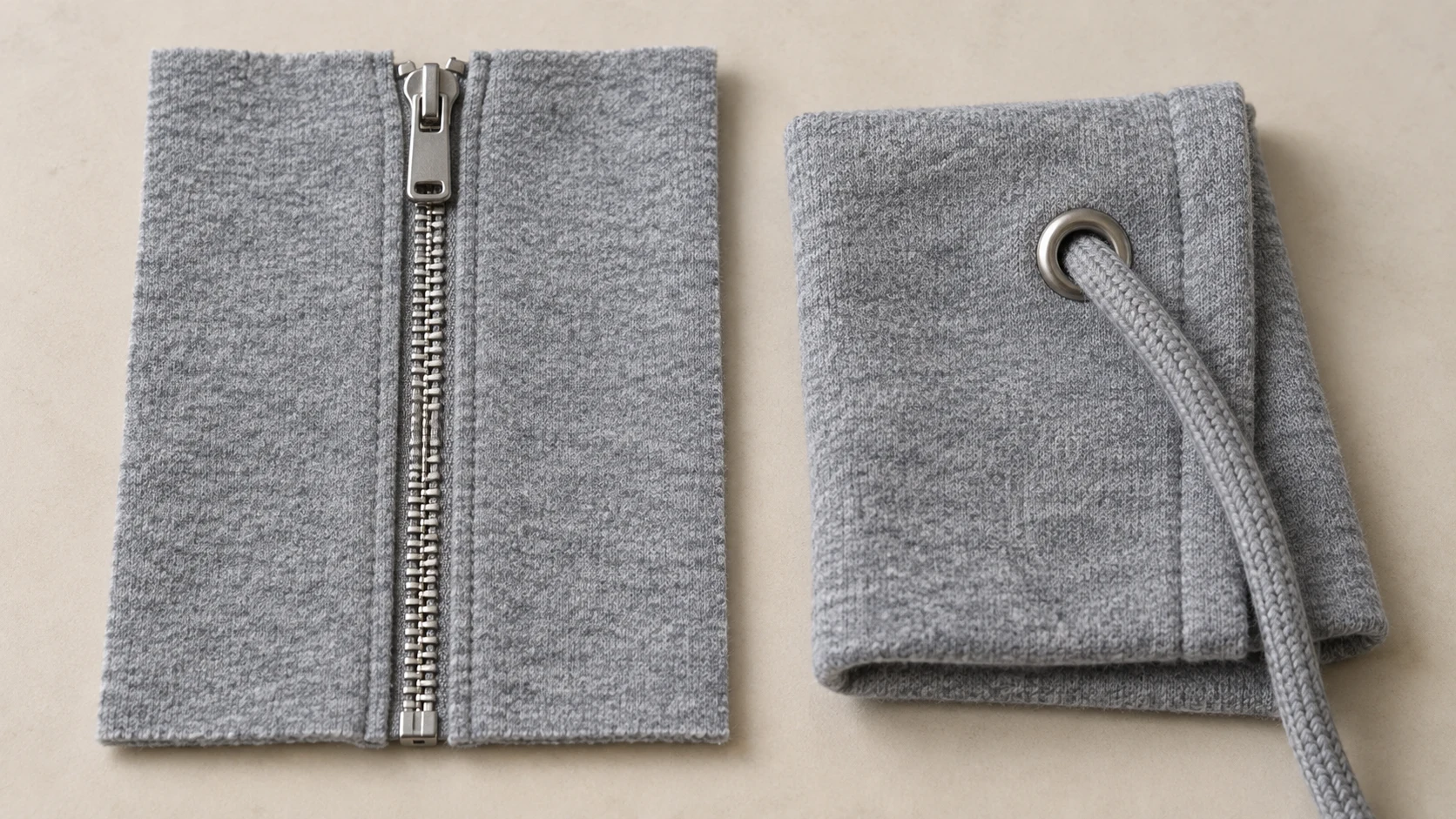
Care compatibility belongs in the review. YKK’s zipper handling guidance advises closing zippers before machine washing or drying and warns against forcing a slider when fabric is caught. Use the instructions for the selected component and the garment’s proposed care process when planning verification. Do not assume that passing a dry opening check predicts appearance or operation after laundering.
Eyelets and hardware: inspect both visible and hidden sides
Review the face, back and fabric beneath each attachment. Look for sharp or rough edges, incomplete seating, damaged fabric, loose backing parts and unintended rotation. Confirm the reinforcement and setting method for the actual fabric thickness. A secure-looking face does not tell the reviewer what is happening underneath it.
Keep visual approval separate from attachment-strength or chemical-compliance evidence. Finish color can be accepted against an agreed physical reference, but a photograph cannot establish coating durability or material compliance. Ask for relevant evidence tied to the supplied component and finish. Where a laboratory test is required, record its scope and applicability rather than treating an unrelated report as approval.
Use three release decisions, not one “approved” message
- Component selection: accept the identified material, finish, dimensions and configuration, with any open requirements listed.
- Assembly approval: accept the way that component is installed and functions on the representative garment after the agreed checks.
- Production release: confirm that the purchase specification, BOM, approved sample and required evidence refer to the same configuration.
Keep the physical reference and approval record connected through golden sample management. If a supplier proposes another zipper, coating, cord or backing part, reopen the affected decision. A similar appearance is not enough to establish equivalence.
For example, an eyelet finish can be visually acceptable while its attachment remains unresolved. Record “finish accepted; assembly release pending reinforcement review” instead of issuing blanket approval. Give the correction an owner and request a revised sample or evidence before releasing the affected operation.
Questions to resolve before the purchase order
Is a supplier trim card enough?
It can establish the selected components and their appearance. It does not replace review of the installed hardware, the garment’s care compatibility or required safety evidence. Keep its approval scope explicit.
Should every size use the same zipper or cord length?
Not automatically. Define the intended size mapping and validate it against the garment pattern and assembled samples. Link any size-dependent component to the size-set approval instead of copying the base-size entry across the order without review.
Can inspection replace development approval?
No. Inspection compares production with an agreed requirement; it cannot resolve an undefined component specification after the goods have been made. Establish the reference and acceptance criteria during development, then carry them into the inspection instructions.
For hoodie trim approval with Yinuo Apparel, send the adult style reference, market, size range, quantity, fabric direction and proposed hardware details. Include available supplier codes and care requirements, and distinguish fixed specifications from options that still need sampling.