

A useful custom clothing manufacturing cost breakdown separates development, production and delivery. A sample, a 50-piece launch and a 300-piece repeat are different purchasing decisions—not three versions of a universal price list. Before comparing suppliers, choose one garment specification, state the quantity per style and color, and ask which costs are one-time and which repeat on every unit.
For a new streetwear brand, the practical question is not “What is your cheapest T-shirt?” It is “What will this approved style cost to develop, produce and receive in my market, and how much cash remains tied up if it sells slowly?” This guide gives you a comparison framework and a quote checklist. Your factory quotation is prepared around the confirmed garment specification, order split and delivery destination.
What belongs in a custom clothing manufacturing quote?
Ask the factory to describe the finished garment before it prices the order: composition, construction, target GSM, fit, colors, size breakdown, decoration, labels and packaging. “Cotton oversized tee” leaves too many different products inside one price. The heavyweight T-shirt development program is a useful starting point when your brief needs a defined cotton weight and boxy fit rather than an unspecified blank.
| Cost group | Ask the supplier to identify | Why it changes the decision |
|---|---|---|
| Development | Pattern work, first sample, revisions, size-set work and sample courier | A prototype is a learning expense, not a miniature bulk order. |
| Production setup | Print screens, embroidery digitizing, wash trials and custom trim setup | Confirm what repeats when artwork, size or color changes. |
| Variable garment cost | Fabric consumption, cutting, sewing, decoration, labels and agreed packing | Compare the same specification and included operations at each quantity. |
| Delivery and import | Freight route, carton basis, insurance, taxes/duties and named delivery place | An ex-factory number is not automatically your delivered inventory cost. |
| Commercial conditions | Payment stages, validity, sample credit, tolerances and permitted over/under delivery | These determine the payable amount and operational exposure. |
Sample vs 50 pieces vs 300 pieces: what should your quote include?
Compare one style, one color and the same garment specification at each stage. A sample quote covers the agreed development work. A bulk quote should show which development and setup costs are included, carried forward or credited, so the same work is not counted twice.
| Quote component | Sample only | 50-piece launch | 300-piece order |
|---|---|---|---|
| Development | Pattern, prototype and agreed revisions | Confirm completed sample work and any remaining approvals | Confirm the same approved specification or identify revisions |
| Production setup | Identify sample-specific artwork or trim setup | Request setup charges by artwork, color and process | Confirm which setup can be shared or reused |
| Garment production | Include only the agreed sample scope | Request a written quote for 50 pieces with the size/color split | Request a comparable quote for 300 pieces with the same scope |
| Commitment | Validate fit, material and workmanship | Test demand with a smaller inventory commitment | Plan deeper inventory against established demand |
| Sample-fee credit | Record eligibility and applicable conditions | Confirm any approved credit in the bulk quotation | Confirm any approved credit in the bulk quotation |
| Freight and import | Confirm sample courier and destination | Request the shipment basis and included charges | Compare air/sea options, carton basis and delivery scope |
To compare production costs, use (development + production setup + quantity × quoted garment cost) ÷ quantity, then account separately for approved credits and delivery charges. A larger quantity spreads shared setup across more garments, but fabric purchasing, sewing efficiency, decoration minimums and color splits can also change the quote. Ask for both quantities in writing instead of assuming a fixed discount.
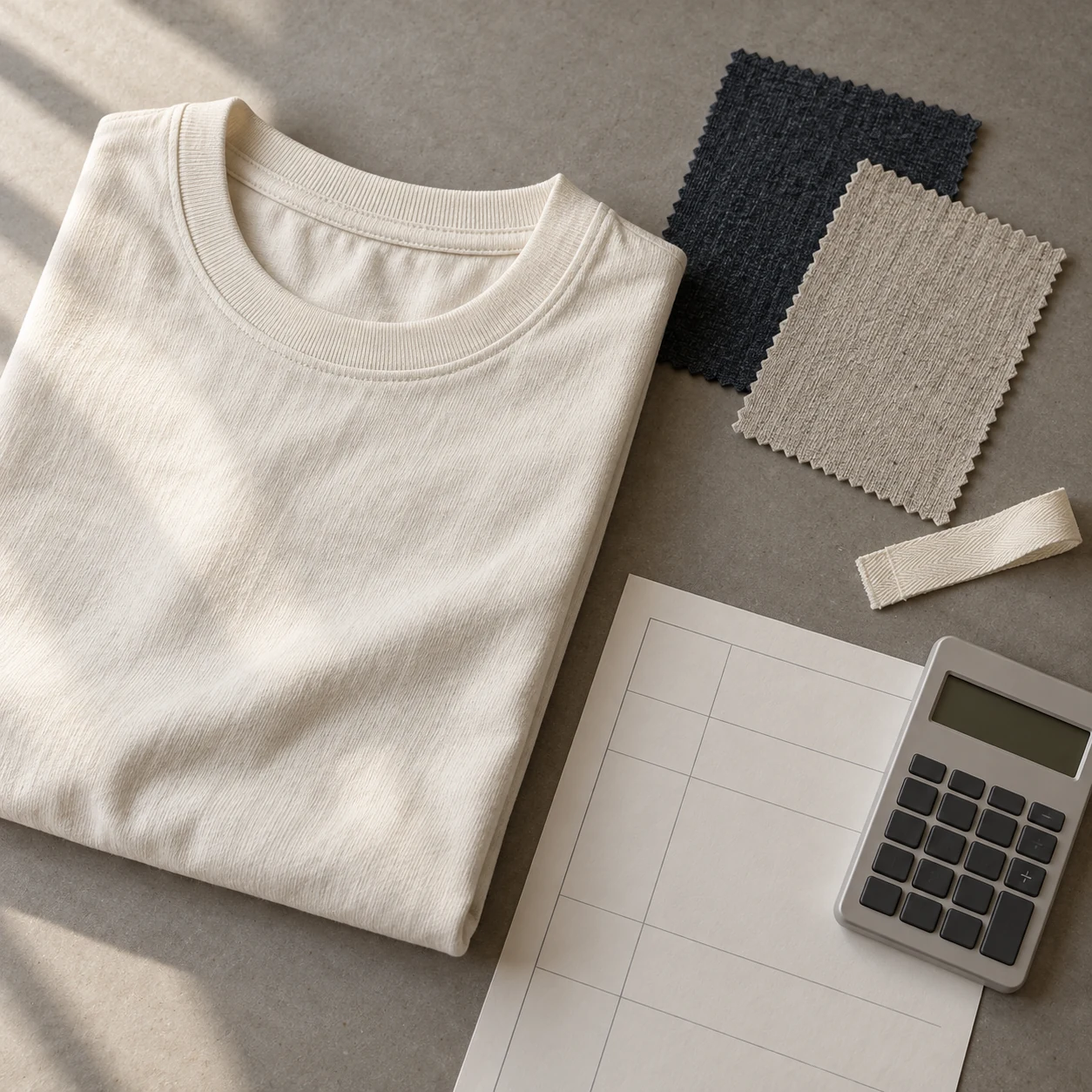
Why a 50-piece launch can be the better first commitment
A 300-piece order can spread shared setup across more garments while committing more cash to inventory. That may be sensible for a proven style, but a first launch also has uncertainty around fit acceptance, customer demand and size distribution. A cheaper unit is not a saving if it becomes unsold inventory. Choose a quantity you can support with an order plan, not simply the column with the lowest average.
For example, 50 pieces split across five sizes produces a different size-depth problem from 50 pieces split across two colors and five sizes. Confirm whether the quoted minimum applies per style, per color or per decoration version. Yinuo’s 20–100-piece small-batch program covers eligible routes; it is not a promise that every fabric, wash or trim can be produced at 20 pieces.
Which choices move the cost most?
Start with the decisions that change the physical product. Higher fabric weight can increase material mass for the same area; a wider oversized pattern also changes consumption. A double-layer hood, special rib, garment wash, oversized print or unusual packaging introduces a different operation or sourcing requirement. Ask for an itemized option rather than assuming a standard percentage surcharge.
For a decorated hoodie, compare the base garment and the puff print or embroidery development separately. Record artwork dimensions, locations, color count, stitch/coverage direction and approval work. For a washed capsule, obtain a separate acid-wash or vintage-finish review; an image reference alone does not define acceptable shade variation or garment dimensions after finishing.
How should sample fee credits and shipping be handled?
Yinuo offers sample fee credit toward eligible bulk orders. Request the applicable amount, qualifying order conditions and timing in the written quotation before treating that credit as available. Apply an approved sample-fee credit once in the relevant bulk quotation, and confirm how it appears on the invoice. Record the qualifying order conditions before including the credit in your launch budget.
Keep development samples separate from a fabric swatch and sample pack. The latter helps review available material and workmanship references; it is not automatically your custom size-and-artwork prototype. Confirm contents, availability, sample cost and courier route. For bulk freight, get the named delivery place and included charges in writing rather than treating “DDP available” as a complete shipping quote.
A quote request you can send today
Use one brief for every shortlisted factory so that quotations remain comparable. Include the garment reference, composition and target GSM, measurements or fit reference, quantity by style/color/size, artwork dimensions, branding, destination and launch window. Ask for sample scope, revision assumptions, unit price at 50 and 300 pieces, setup charges, lead-time approval gates and delivered-cost exclusions.
Configure a factory quote request with the quantity you are actually considering. An accurate custom clothing manufacturing cost breakdown should help you decide which specification and commitment fit the launch—not disguise incomplete scope behind an attractive unit number.
Is there one reliable price for a custom hoodie or T-shirt?
No. A useful price belongs to a defined specification, order split, included services, delivery basis and validity period. Request a project-specific quotation after confirming those details.
Should I skip sampling to reduce the first order cost?
Do not treat an unapproved design as ready for bulk. Instead, agree which development questions the sample must resolve and obtain a clear revision and approval scope before production.