

Clothing reorders need a new sample when an unresolved change must be checked in the finished garment before production proceeds. An existing approval may remain useful when the product definition is unchanged and current evidence supports carrying it forward. Decide whether the open question concerns a material, a garment or only its packaging before requesting a complete sampling cycle.
For brands replenishing an established style, the useful decision is how much approval work to repeat. A revised size allocation does not automatically create a new fit. A replacement fabric can create a garment-level question even when the style name stays unchanged. Your buyer procedures and product risks determine the required review.
Choose the smallest review that can settle the open question
Use these three routes as a planning aid. A limited review is appropriate only when its evidence covers the affected features and related risks.
| Review route | When to consider it | Evidence needed before release |
|---|---|---|
| Carry forward the existing product approval | Approved requirements remain unchanged and available; no unresolved issue invalidates the reference | Identified document/sample versions, current input confirmation and an agreed production-control plan |
| Approve a changed component or operation | The change can be assessed separately, with its effects on the garment understood | A relevant swatch, decoration trial, component submission or packing proof, plus any linked checks |
| Review a new garment sample or affected sizes | Fit, construction or interacting materials remain uncertain | A representative sewn sample, measurements and applicable performance evidence against agreed criteria |
Confirm what the supplier means by a confirmation sample or pre-production sample. Record the actual fabric, trims, processes and sizes represented. The sample’s name cannot establish that coverage.
Reconcile the reference before deciding to reuse it
Start with the final accepted product version, including changes approved during the previous run. Compare the retained garment with the current specification and bill of materials. If they disagree, resolve the discrepancy before asking the factory to reproduce either one.
A controlled golden sample helps preserve construction and appearance references. It still needs an identity and approval scope. A showroom sample in an alternative fabric, for example, may illustrate the silhouette while leaving the intended production material unapproved.
A different size mix is different from an unapproved size
Changing how many units you order in already-approved sizes does not itself revise their measurements. First check whether the factory proposes any associated pattern, material or process change. Keep the allocation decision separate from the evidence supporting each size.
In a hypothetical navy-polo reorder, S, M and L already have approved specifications and supporting size reviews. The previous allocation was 90 S, 90 M and 60 L. The new allocation is 40 S, 120 M and 80 L. Both total 240 units; the change moves quantities between the existing sizes.
That arithmetic provides no new reason to alter the approved fit. It also provides no evidence that the next run will meet it. Confirm the size-specific labels, material availability and cutting quantities, then apply the agreed current-run checks. Reopening fit development solely because M now has more units would not answer those order-allocation questions.
Adding an unreviewed XS is a separate decision. Establish its specification and the evidence needed to approve it. Use a size-grading and size-set review for the affected coverage. A base-size sample cannot demonstrate every added size, and a previous size chart should not be assumed to prove physical fit.
Ask whether a material change needs a sewn trial
For a proposed replacement fabric or trim, identify the garment feature that could change. Ask what evidence would demonstrate an acceptable result. A color submission answers a different question from a sewn trial of a collar, seam or waistband.
If the question concerns dimensions after care, request relevant laundering evidence. AATCC TM150-2025 addresses dimensional changes of garments after home laundering; its public scope also notes limitations for certain stretch fabrics. Agree the suitable method, conditions and acceptance criteria. A familiar GSM description or an unwashed photograph cannot establish the result of that test.
Use the existing garment shrinkage approval brief to keep measurements and test conditions consistent. A new lot is a reason to review the evidence plan, not an automatic instruction to repeat every sample stage. Request a sewn trial when the unanswered question depends on the assembled garment.
A packing-only change needs a packing decision
If an unchanged garment gets a new insert card, review the revised artwork and packed presentation. Check the intended card version and whether it fits the agreed pack. Repeating a fit sample would not establish which card reaches the customer.
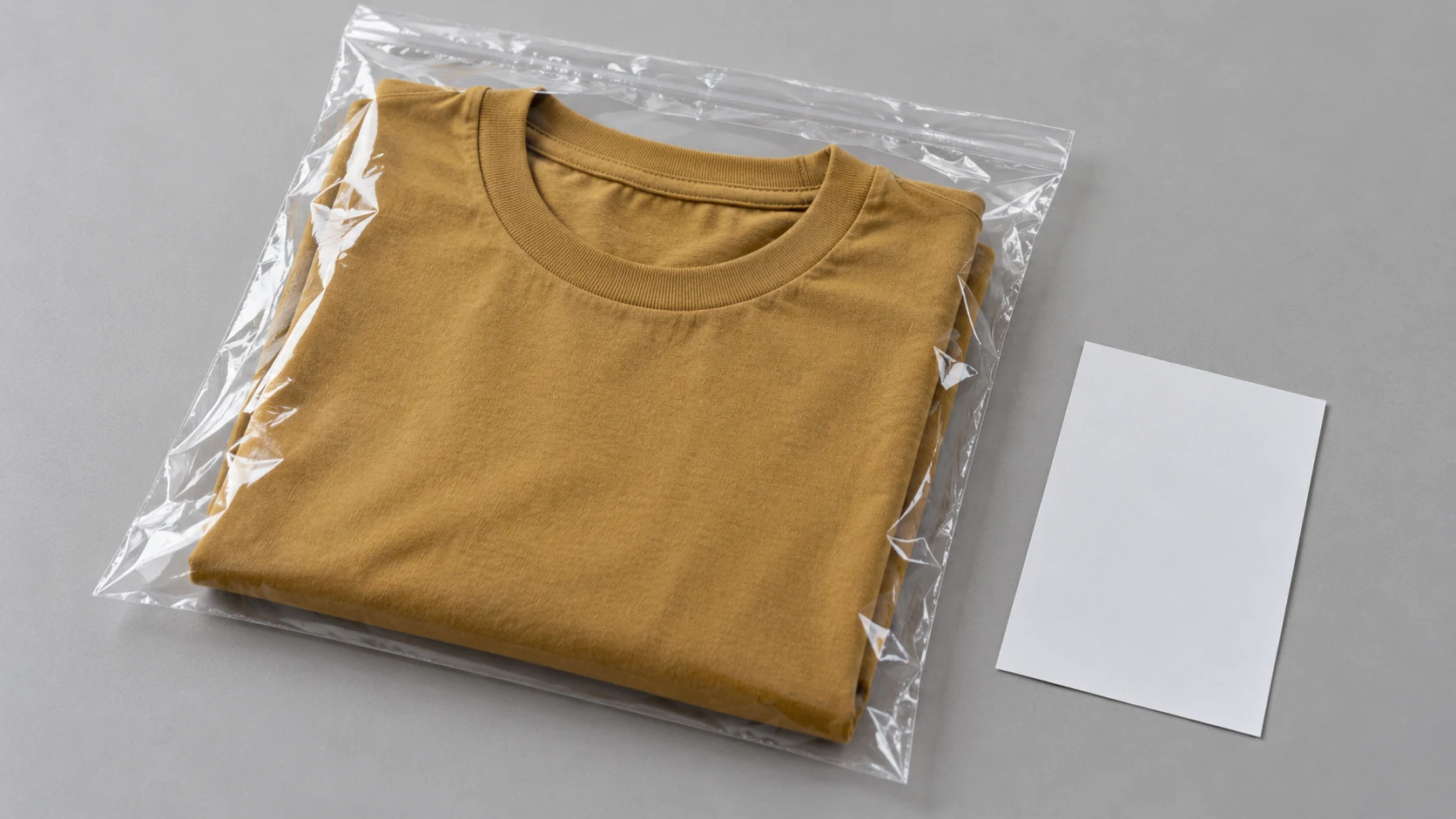
When a change includes identifiers, verify the printed data against the current order and the agreed receiving requirements. A photo that shows a card is present does not establish the data is correct. Use the retail-ready packaging checklist for the broader packing scope.
Make the reorder approval note specific to each operation
For the hypothetical polo reorder, assume the product evidence supports reuse and only the insert card remains open. The following is illustrative wording to adapt, not a real approval or a substitute for your agreed procedure:
Carry forward the recorded S, M and L product approval for this reorder against the identified specification and BOM revisions. Cutting to the confirmed size allocation may begin only after the agreed incoming-material checks have passed. Packing remains on hold pending approval of the revised insert artwork and a packed-unit proof. This note does not approve substitutions or shipment release.
Replace the generic references with actual revision IDs and evidence links. Add the decision owner and date. Ask the supplier to acknowledge the permitted work and hold point before work starts. If material evidence is still open, the cutting permission in this example would need to change.
Sample approval and production inspection have separate jobs
Carrying forward product approval does not remove the need to check the current run. Intertek’s initial production check description includes verifying current raw materials, components and accessories against specifications. Agree the inspection scope and timing for your order instead of treating the retained sample as evidence about goods not yet examined.
For clothing reorders, send Yinuo Apparel the previous approved version and proposed changes, together with the new quantity breakdown and required delivery date. Ask which approvals can carry forward, what needs a fresh submission and which production steps must wait. Confirm the current quote and schedule separately from the sample decision.