

Specify fabric stretch and recovery by naming the test method, material direction, loading or extension conditions, recovery interval and acceptance limits. Request results for the intended finished fabric, then confirm the garment’s fit and function separately. A supplier’s “40% stretch” statement is incomplete without the conditions behind it and evidence of what happens after the load is removed.
This matters when sourcing a T-shirt that must move comfortably, a cuff that should retain its opening or joggers whose knees need to keep an acceptable shape. The buyer’s job is to turn those product expectations into a comparable material specification. “Good elasticity” gives a mill too little information to price, sample and verify consistently.
What does a fabric stretch and recovery report measure?
Use the report’s defined terms rather than treating every percentage as an elasticity score. Stretch describes extension under specified conditions. Growth concerns the remaining dimensional increase after extension and release. Recovery describes the return toward the original state, with its timing and calculation needing an explicit basis.
| Result or claim | Question it helps answer | Information to request |
|---|---|---|
| Fabric stretch or elongation | How far does this material extend in the stated test? | Direction, force or loading basis and method. |
| Fabric growth after release | How much dimensional increase remains at assessment? | Prior extension, recovery interval and calculation basis. |
| Recovery percentage | How is the return from extension being expressed? | The exact definition, formula and time of measurement. |
Do not calculate recovery as “100 minus growth” unless the chosen method actually defines it that way. The quantities may use different reference lengths. Ask the laboratory to identify what each reported percentage means before transferring a number into a purchase specification.
Keep these performance fields within the broader apparel fabric specification. Fiber composition, construction, weight and finishing identify the material, but none should substitute for the particular performance evidence your product requires.
Choose a method that fits the material and end use
The public scope of ASTM D2594/D2594M-21 addresses knitted fabrics with high stretch and good recovery under low tension. It measures stretch under a known load and evaluates growth after a known extension is removed. Those procedures may be used together or separately. A report citing the method therefore still needs to identify which results were obtained.
That scope also directs support applications toward other methods. Do not automatically apply a comfort-stretch knit specification to a product intended to provide substantial support. Have the laboratory confirm the method’s suitability for the actual fabric and intended use.
ISO 20932-1:2018 describes elasticity-related testing with fabric strips or loops and excludes narrow fabrics; its official listing includes an amendment. Specify the applicable edition and amendments with the laboratory. A cuff fabric, narrow elastic and finished waistband should not be treated as interchangeable test articles.
Use hand checks to identify questions, then request evidence
A gentle hand comparison can help a development team notice that samples feel different or that the direction of extension needs clarification. It cannot establish a repeatable percentage when the force, grip spacing and timing are uncontrolled. Record the observation and use it to brief the supplier instead of presenting it as a laboratory result.
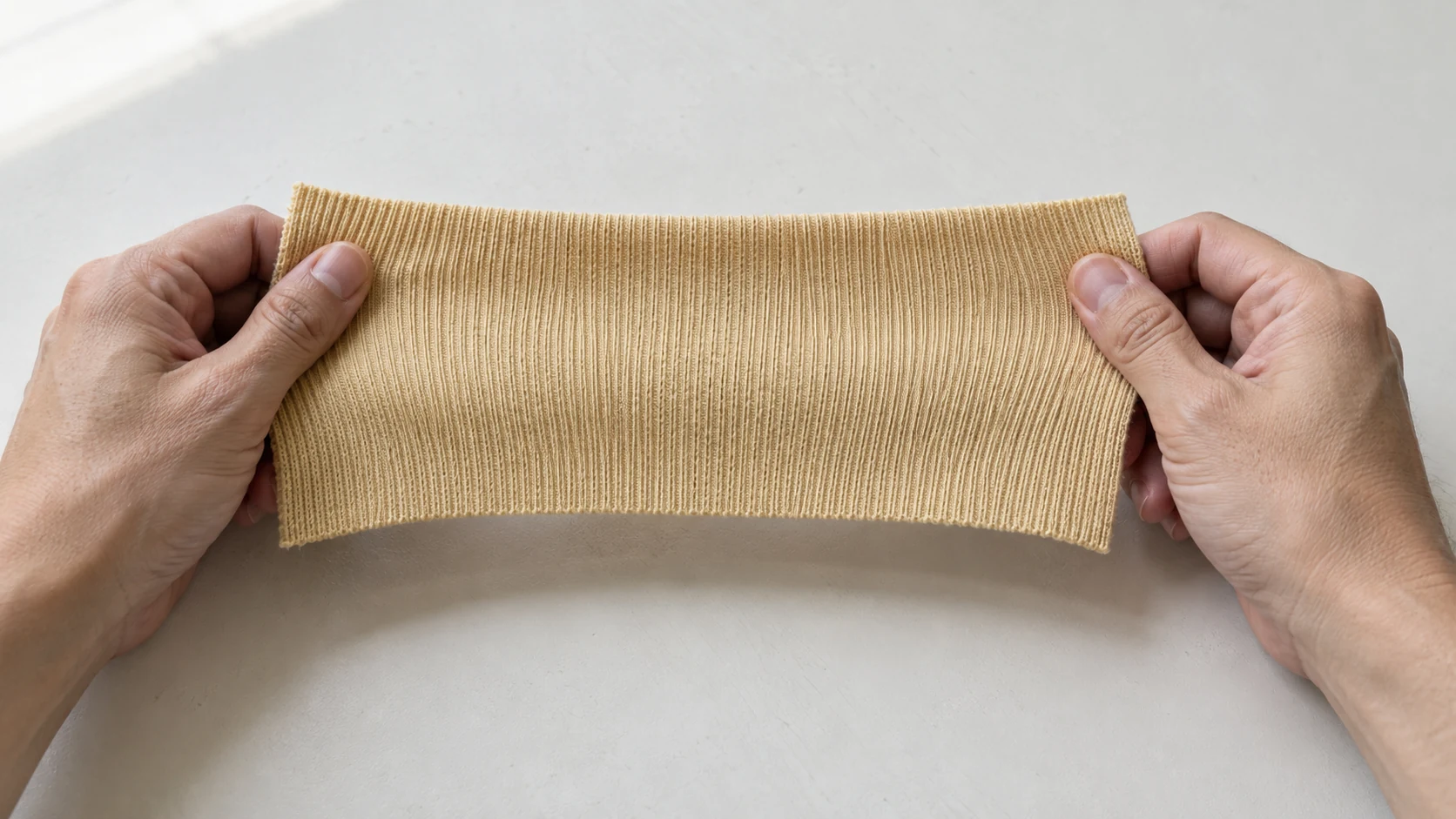
Mark the material orientation on the submitted sample and explain how it relates to the garment pattern. Request separate results for each direction that matters to the product. Terms such as “two-way” or “four-way” should be accompanied by a direction sketch or clear material axes, not left to interpretation between teams.
Compare report conditions before comparing percentages
ASTM D4964-96(2020) covers tension and elongation of elastic fabrics using a constant-rate-of-extension machine. Its guidance says comparisons of loop tension-recovery data depend on comparable equipment, extension rate, loading or extension limits and specimens. Different setups can produce different results on the same fabric.
When reviewing competing materials, ask the laboratory to align the relevant conditions under the selected method. Check the material identity and tested state as carefully as the result: sample-yardage fabric, finished bulk fabric and a washed specimen are different evidence records.
- Fabric article, lot, color, finish and sample source.
- Method, edition, applicable procedure and any reported deviations.
- Specimen orientation, dimensions and preparation.
- Relevant load or extension, duration, repetitions and recovery interval.
- Conditioning and any agreed laundering before assessment.
- Individual results or reported variation, calculation basis and acceptance decision.
Not every field applies in the same way to every method. Use this list to check report completeness with the laboratory, not to assemble a new test from unrelated procedures. If an existing supplier report lacks the necessary details, resolve the missing basis before ranking the materials.
Define the limit around the product decision
There is no single buyer-defined stretch target that suits every T-shirt, jogger and trim. Agree the requirement using the intended fit, movement and appearance expectations, then verify it through suitable samples. Increasing the permitted extension does not by itself settle whether the garment will feel right or retain its shape.
Hypothetical report review: one supplier reports 40% stretch but omits the load and direction; another supplies a lower percentage with a complete method and growth result. The percentages alone do not establish which fabric is better. First obtain comparable evidence, then judge both against the product requirement. These figures illustrate missing information, not recommended limits or factory results.
For hoodie cuffs and rib trims, keep the fabric result connected to the finished opening and attachment details. Record approval by component so a body-fabric result does not silently become approval for every trim.
Confirm the finished garment and record the approval
Use the accepted material in a production-intent garment sample. Review dressing, movement, fit and appearance under the agreed care and assessment conditions. If knees, elbows or openings retain an unwanted shape, document the location and investigate it with the supplier. A garment photograph shows the observation; it cannot establish a laboratory fabric-growth value.
Check the seam construction and required extension as part of that review. A passing fabric result does not establish that every seam, print, tape or trim in the assembled product meets its intended function. Keep the material report and garment approval linked but separately identifiable.
Add the agreed fabric stretch and recovery requirements to the relevant bill-of-materials entry, with report references, acceptance limits, approval owner and revision. Define what changes require renewed review, such as a different fabric article, finishing route or component substitution.
To discuss fabric stretch and recovery with Yinuo Apparel, send the garment tech pack, intended fit and use, fabric specification, direction sketch and available test reports. Include the care requirements and any sample area that loses its intended shape so the next material or garment trial can address a clear question.