

Approve fusible interlining as a complete combination: the identified outer fabric, the selected interlining, the production fusing process and the finished shirt after the agreed care treatment. A loose swatch that feels firm enough is only a candidate. It does not establish that a collar, cuff or placket will have the intended appearance once bonded, sewn and washed.
Fusible interlining is a supporting material bonded to the reverse of outer fabric using its adhesive coating. For buyers, the important approval is the resulting assembly, not the interlining roll in isolation. This guide focuses on woven shirts and blouses; it is a purchasing checklist, not a universal press-setting recipe or a substitute for the material supplier’s instructions.
Start with the collar, cuff and placket you want
Replace “use good quality interlining” with a description that a sample reviewer can judge. For the collar, describe the intended roll, point shape and stand support. For cuffs, specify the required flexibility and appearance when fastened. For the front placket, agree how it should lie when the shirt is buttoned and how much stiffness is acceptable.
A soft casual shirt and a structured business shirt may need different approved results even when their outer fabrics look similar. Keep an agreed reference for appearance and hand feel, but identify which component it represents. A cuff reference should not silently become the specification for every part of the garment.
Put these requirements in the sampling tech pack, with the interlining coverage and construction drawing. Record whether a component uses one layer, a local reinforcement or another approved arrangement. Do not leave the sample room to infer those choices from a photograph.
Lock the exact pair for fusible interlining approval
Request the interlining maker and article code, base construction, color, weight specification, coating reference where supplied, and current technical sheet. Identify the outer-fabric article, color, lot or development reference and finishing state alongside it. “White shirt interlining” is not a sufficiently precise substitution rule.
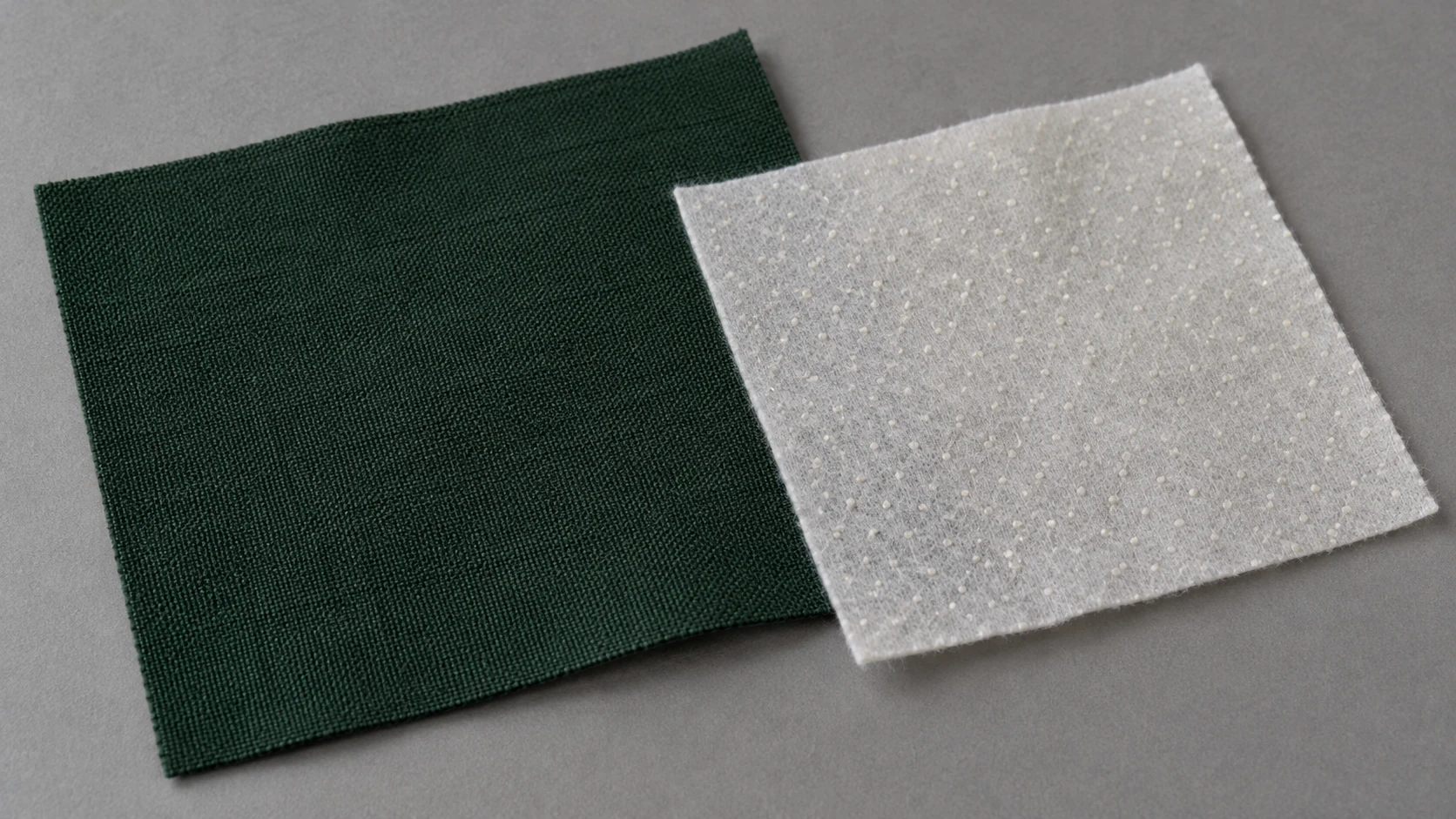
Ask which side and cutting direction the supplier specifies, then show that orientation on the component pattern. For example, Vlieseline’s G 700 instructions distinguish coating orientation, cutting direction and a flat cooling step. Those instructions belong to that product and application route; they are not a recipe to copy onto a different interlining or an industrial press.
Link each approved interlining to its garment location in the apparel bill of materials. If one article will cover several colors or fabric lots, ask for the proposed trial coverage and approve the rationale. A familiar supplier name does not remove the need to identify the actual material pair.
Make the fusing trial reproducible on the production route
Wendler’s fusing guidance treats temperature, pressure and time as a combination to balance, rather than variables to keep increasing. It also advises testing the actual fabric–interlining combination and letting fused parts cool before further handling. A good-looking sample made under an unknown process is difficult to transfer into production.
Ask the factory to record the trial on the equipment intended for the order. Distinguish the machine’s displayed setting from the fuseline temperature—the temperature at the bonding interface. Have the responsible technician state how the relevant conditions were checked. A domestic-iron trial and a conveyor-press trial should not be treated as an identical process merely because a displayed temperature matches.
Freudenberg’s 2023 shirt-interlining announcement, for example, describes a product-specific fuseline temperature and care capability. It illustrates why processing and care claims must stay with the identified product. Request a current technical sheet for the article being proposed; this historical example is not a recommendation of that product or a statement that Yinuo uses it.
Keep a short trial record containing:
- Both material references, component pattern revision and cutting orientation.
- Press identity and the supplier’s applicable processing guidance.
- Recorded temperature, pressure and dwell-time basis, plus cooling and handling arrangements.
- Trial date, operator or responsible technician, and clearly identified retained pieces.
- Results of appearance, hand-feel and any agreed bond assessment, with the acceptance rule.
If quantitative bond testing is required, agree the method, specimen preparation, units and acceptance criterion with the technical team or laboratory. A hand peel can flag a concern but should not be presented as a measured bond-strength result. Keep this trial record with the samples rather than reconstructing settings from messages later.
Check the cooled assembly, care result and sewn shirt
Review the fused pieces after the prescribed cooling stage, then assess representative sewn components and a finished shirt. Agree the wash, dry and finishing sequence, number of cycles and inspection stage before the trial. A material’s own care recommendation does not automatically approve the care instructions of the complete garment.
| Review point | What to record | What it does not establish |
|---|---|---|
| Cooled fused piece | Face appearance, feel, edge behavior and any visible coating or color change. | A smooth face alone does not prove adequate bond strength. |
| After agreed care | New bubbles, separation, waviness or dimensional change compared with its identified baseline. | A photograph does not establish the root cause or a numerical peel value. |
| Sewn collar and cuff | Roll, support, seam bulk, point shape and appearance when fastened. | A passing flat coupon does not approve the finished construction. |
| Finished shirt | Placket lie, buttoning, overall appearance and agreed hand feel. | One approved sample does not authorize an unrecorded material change. |
If bubbling or separation appears after washing, hold the combination for investigation. Wendler identifies several possible contributors, including processing conditions, unsuitable combinations and care conditions. Do not diagnose every bubble as “not enough heat” and immediately raise the press setting. Preserve the affected piece and its trial record so the supplier can investigate.
Keep the dimensional-change review alongside the appearance review. Use the same agreed measurement points and preparation state for before-and-after comparisons. If pressing is part of the inspection sequence, document it; do not conceal a failed after-care appearance through an unagreed re-fusing step.
Release a defined combination, not an open-ended substitute
Approve the material pair and process only after the agreed checks are complete. Name the decision owner, list any restrictions and retain both the identified trial pieces and the approved shirt sample. That creates a reference for purchasing, cutting, fusing and final inspection.
Reopen approval when the outer fabric or finish changes, the interlining article or coating changes, or a different production route is proposed. Ask which previous evidence remains applicable and which trials must be repeated. Do not let a lower-cost replacement enter the order under the vague description “equivalent interlining.”
Planning a shirt order? Send Yinuo Apparel your brief, outer-fabric reference, collar and cuff requirements, proposed care instructions and available fusible interlining trial records. Identify the unresolved decisions so the discussion can address the actual garment and production route.