

A lower sewing quote is not necessarily a lower-cost clothing order. If your team must buy the fabric, coordinate delivery, resolve shortages and manage leftover material, those tasks sit outside the factory’s sewing price. Comparing that number with a quote for finished garments can lead to the wrong production decision.
For CMT vs full-package apparel production, choose by who can reliably manage materials and exceptions. CMT can fit when your team has an approved material source and someone accountable for getting usable inputs to the factory. Full-package production can fit when you want the manufacturer to procure the agreed inputs. Neither route removes your responsibility to define the product and approve it.
Which route fits your current situation?
| Your situation | Route to investigate | Condition before committing |
|---|---|---|
| Approved fabric source and a person managing procurement | CMT with a written input list | Factory accepts the material, quantities and delivery plan |
| Defined garment, but no capacity to manage material suppliers | Full-package production | Material specification, approvals and exclusions are explicit |
| One essential nominated fabric, with other inputs unresolved | A mixed procurement scope | Purchasing, payment and exception ownership are assigned separately |
| Fit, fabric or construction still undecided | Development before a firm bulk comparison | Both quotes eventually use the same approved specification |
What do CMT and full package actually include?
CMT stands for cut, make and trim, but the label alone does not establish who supplies every component. For example, CBI’s apparel costing guide distinguishes labour-only CM from CMT that includes factory-managed trims. Ask each supplier to define its usage rather than assuming that “CMT” means you must supply every button, label and bag.
In this guide, full package means the manufacturer procures the agreed materials and manages garment production within a specified scope. It does not automatically include original design, unlimited sampling, independent testing or delivery to your warehouse. Those are separate inclusions to confirm.
Keep this procurement decision separate from OEM vs ODM development responsibility. A buyer can own a complete design while asking the factory to purchase its materials. Design ownership and material purchasing are not the same question.
Choose CMT only if you can close the material handoff
A mill contact is a starting point, not a complete sourcing system. Before choosing CMT manufacturing, confirm that someone on your team can release purchase orders, track deliveries, review incoming information and make decisions when the material differs from the approved reference. That person needs authority, not just access to the email thread.
Get the factory’s written acceptance of buyer-supplied fabric before ordering it. Provide the actual construction and finish, usable width, quantity, intended garment and relevant approval evidence. Ask what receiving checks the factory will perform and what it will report before cutting. Do not treat a booked sewing slot as approval of an unseen fabric.
Then test the awkward cases. Who acts if a roll is short, shade groups cannot be combined, a zipper delivery is incomplete or the approved material becomes unavailable? Define who investigates, who authorizes a replacement and how additional costs are agreed. A sourcing plan is incomplete if everyone can place an order but nobody owns a failed handoff.
Connect material-ready dates to the sampling and approval timeline. Ask the factory which inputs must be accepted before it confirms the production slot and what happens when an input is late. Do not assume that switching to CMT automatically shortens production time.
Choose full package when procurement support solves a real gap
Full-package production is worth considering when you can approve a garment but cannot consistently coordinate the material supply behind it. Evaluate the supplier’s proposed sourcing and approval workflow, rather than treating “one supplier” as evidence that all problems have disappeared.
Keep control of the acceptance standard. Record the approved fabric reference, composition requirement, construction, color, finish and any agreed performance criteria. Require written approval before substitutions. A proposed alternative needs a comparison against those requirements, not simply the description “equivalent quality.”
Ask how material commitments are handled if quantities change or the order is cancelled. Who funds a mill minimum, owns an unused balance, pays storage and approves later reuse? These are questions for the quotation and order terms; do not assume that a finished-garment price transfers every unused-material obligation to the factory.
A mixed scope needs three names against each input
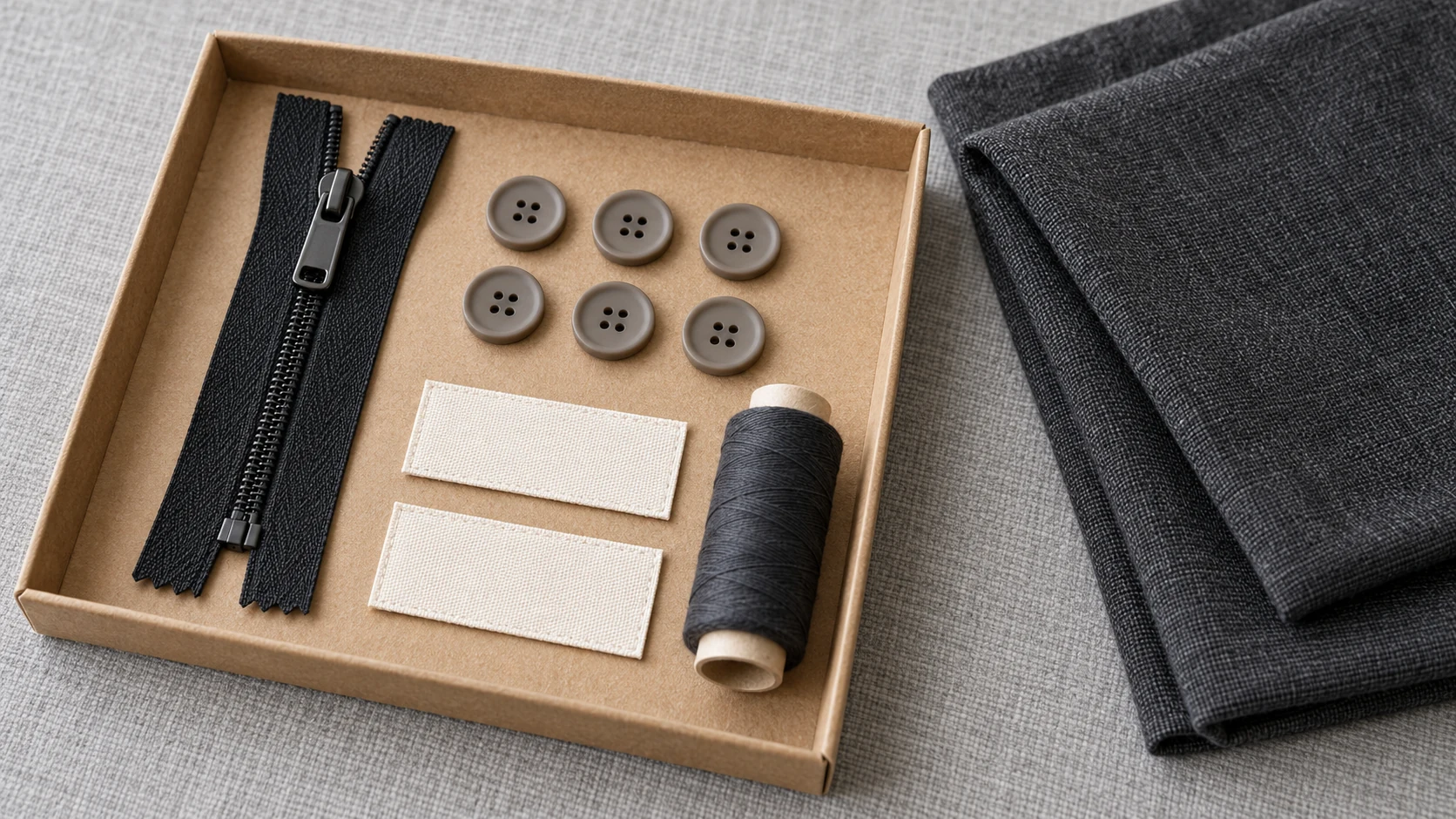
Suppose your brand requires a particular fabric mill but wants the garment manufacturer to arrange trims. First establish whether you buy the fabric directly or nominate the mill for the manufacturer to buy from. Those arrangements are different, even if the material is identical.
Add three fields to the apparel bill of materials: purchaser, approver and exception owner. The purchaser places the order; the approver accepts the reference or change; the exception owner coordinates the response to a shortage or nonconformity. One party can fill several roles, but no role should be left implicit. Record the payer separately when it differs from the purchaser.
Compare quotes at the same scope, not just per piece
Send both suppliers the same garment specification, quantity breakdown, sample reference, decoration and packing requirements. Ask them to mark each cost as included, separately charged or buyer-supplied. Compare fabric and trims, development, decoration, receiving checks, agreed testing, packing and transport to the same handover point. Use the custom clothing cost drivers to identify missing lines, not to assume a standard markup.
Keep cash commitments and internal work visible alongside supplier charges. A material balance that your team owns is not the same as fabric consumed in the garments; time spent coordinating suppliers is not a sewing charge. Record these separately so neither route wins because its costs were left out. Request actual quotations rather than applying a universal CMT saving percentage.
Also separate the manufacturing package from the shipping term. “Full package” does not specify freight cost or risk transfer. If a quotation uses an Incoterms rule, confirm the rule, version and precise named place or port. The ICC’s Incoterms 2020 guidance explains why that location matters. Do not treat “FOB” as another name for warehouse delivery.
How the decision changes in three situations
An established fabric programme: your team already purchases an approved fabric and can manage its arrival and exceptions. Investigate CMT, subject to the factory accepting that material and the full receiving-to-cutting handoff. An attractive fabric price alone is not enough.
A new category without a sourcing owner: your team knows the product outcome but has no one available to manage its material suppliers. Investigate full package with a documented approval process. If the product itself is unresolved, commission the development work before treating a bulk estimate as a firm comparison.
A repeat style moving between models: preserve the approved product baseline while changing procurement. Transfer specifications, component references and the golden sample record, then confirm material balances and access to the required production files. Avoid changing fabric, fit and sourcing responsibility simultaneously unless you deliberately plan fresh approvals.
Before you approve the manufacturing scope
| Action | Evidence to agree |
|---|---|
| Assign every material and packing item | BOM showing purchaser, payer, approver and exception owner |
| Define usable-input acceptance | Receiving checks, reporting method and release-before-cutting decision |
| Control changes and shortages | Written substitution approval and additional-cost authorization process |
| Allocate balances and commitments | Unused-material ownership, storage, cancellation and reuse terms |
| Normalize both quotations | Same product, quantity, included services and handover point |
| Connect approval to the schedule | Named decision-makers, input-ready dates and production-slot conditions |
The practical answer to CMT vs full-package apparel production is to choose the scope your team and supplier can actually operate, then put the handoffs in writing. To discuss a suitable scope with Yinuo Apparel, send your project brief with the product reference, quantity by style and color, target delivery window, existing material sources and the procurement tasks you want the manufacturer to quote.