

Elastic waistband approval should cover the finished waist opening, the elastic specification, the force needed at agreed extensions, and the assembled garment’s fit after care. A relaxed measurement alone does not establish comfort or pull-on access. Approve the band together with its casing, join and stitching before releasing the style for bulk production.
Two pairs of shorts can have the same relaxed waist width yet feel different when worn. One band may resist extension more strongly; another may roll inside its casing. For apparel buyers, the useful question is not simply whether the elastic stretches. It is whether the complete waistband gives the intended fit, opening and appearance across the ordered sizes.
Separate waist dimensions from elastic cut length
Keep the body-size chart, finished garment measurement and elastic cutting instruction in separate fields. Body waist circumference describes the intended wearer. Relaxed garment waist width describes the assembled sample under a defined measuring condition. Elastic cut length describes a component before it is joined and sewn into the waistband.
In the sampling tech pack, show where the waistband is measured, whether the value is a flat width or circumference, and how gathers are arranged without pulling the band. Record the finished waistband height separately from the elastic tape width. A band containing elastic is not necessarily the same height as that elastic.
If the factory uses an overlap join, distinguish the cut length from the completed elastic ring length. If it proposes a different joint, update the drawing and component instruction. Avoid a universal rule such as cutting every elastic a fixed amount below body waist size: the material’s resistance, garment construction and intended fit still need sample review.
Specify the elastic and its attachment as one system
Identify the approved trim by supplier article, construction, width, color and available composition information. A generic description such as “soft elastic” is not enough to control substitution. Link the trim reference to its bill-of-materials entry, including the approved sample and any performance report.
Then define how the elastic is used: loose inside a casing, secured at named points, stitched through in rows, or exposed at the garment edge. Show the joint location and finishing. Review the proposed sewing route with the supplier rather than specifying a machine setting without trials on the actual material combination.
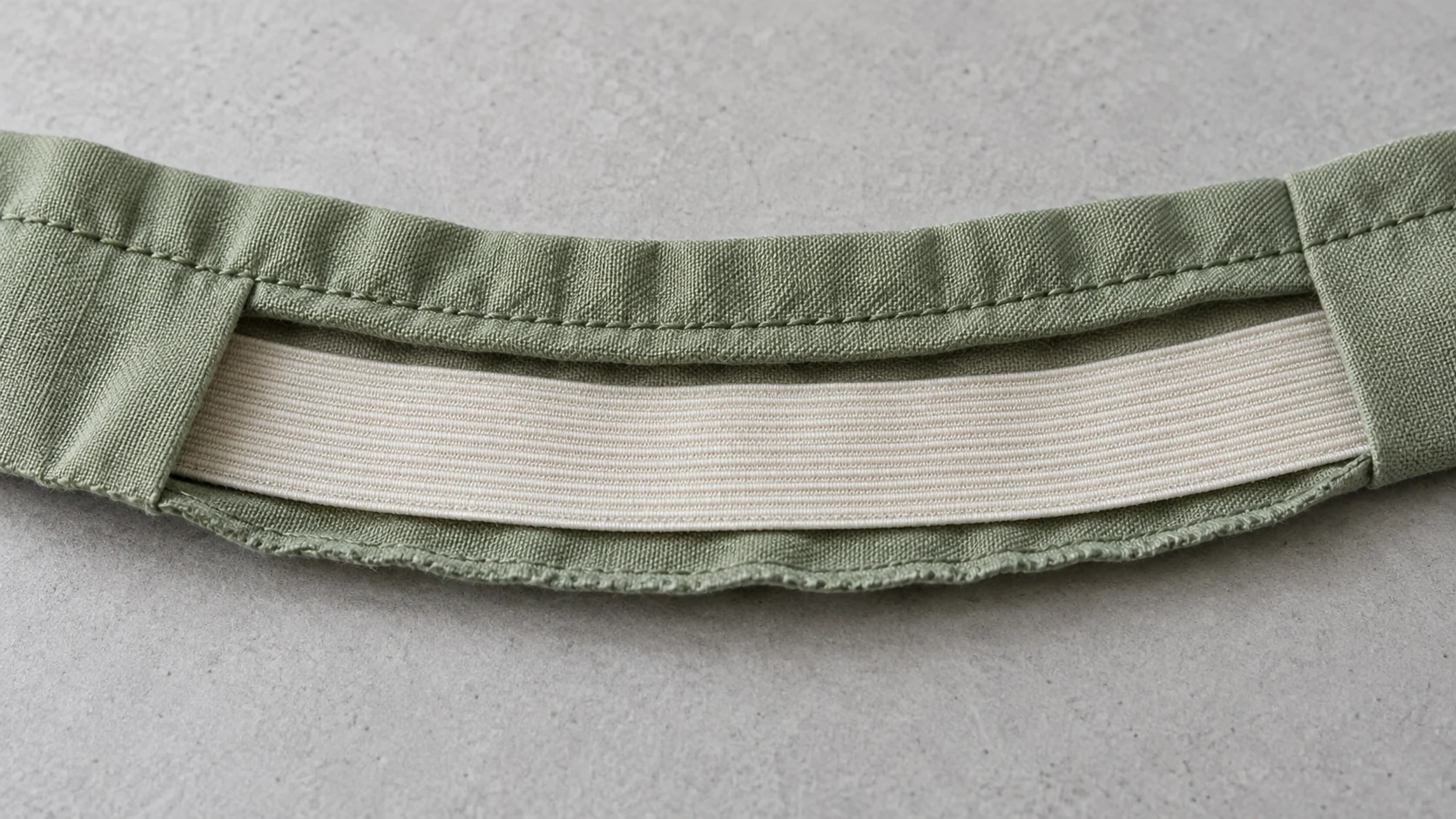
Check whether the elastic lies flat, gathers distribute as intended, and the join creates an unwanted hard or bulky area. A casing that looks neat in a flat photograph still needs assessment when the waistband opens and returns. If rolling or twisting appears, ask the team to investigate the tape, casing dimensions and securing arrangement together.
Why is “stretched waist” an incomplete requirement?
“Stretch fully” gives inspectors no repeatable stopping point. Different people may apply different forces, and the seam or casing may limit the opening before the elastic does. For a dimensional check under extension, agree the force or other defined endpoint, apparatus, handling and timing with the supplier. Identify whether the check concerns loose elastic, a joined ring or the finished waistband.
The public scope of ASTM D4964-96(2020) covers tension and elongation of wide or narrow elastic fabrics on a constant-rate-of-extension machine. It requires agreed tension or elongation points and agreed laundering conditions when used. Ask a qualified laboratory whether that method fits the proposed trim; citing it does not establish a pass limit or approve the finished garment.
For comparing elastic options, request force at the same agreed extension rather than ranking them by maximum stretch alone. Keep specimen and test conditions comparable. For garment acceptance, use separately defined checks of dressing, fit and movement. A hand pull is useful for noticing a difference, but it is not a controlled force result.
Review the sewn waistband on the intended wearer
For pull-on shorts or trousers, review passage over the hips as well as fit at the intended waist position. Use the agreed fit model or wearer range. Check sitting, bending and ordinary movement appropriate to the product, then note pressure, slipping, rolling and the appearance of the waistband. Do not treat a brief fit trial as proof of long-term wear performance.
Inspect the stitching while the sample opens to the agreed functional range. Look for thread breaks, skipped stitches, seam damage or a local restriction. Coats’ technical guidance on soft and secure stretch seams discusses the relationship between needle tension and seam elongation, and recommends checking stretch after tension changes. A more extensible trim cannot compensate for an attachment that limits the opening.
Keep dimensional measurement tolerances separate from functional acceptance. Passing the relaxed waist measurement should not override a documented fit or construction problem. Record the location, sample identity and observation so the next trial answers a specific question.
Repeat the review after care and across sizes
Agree the wash and drying procedure, number of cycles, rest period and assessment condition before comparing samples. Examine the complete waistband after that care sequence for changes in opening, gathers, join appearance and return to the intended shape. Record before-and-after measurements using the same defined method; do not measure one sample immediately after pulling and another after resting.
A base-size approval is not automatically an elastic-length rule for the full order. Review the size set and grading plan with finished waist dimensions and component lengths clearly identified. Check representative sizes where the opening or fit remains uncertain. If elastic width or attachment changes within the range, treat that as a separate construction decision.
What belongs in the elastic waistband approval record?
Release one traceable specification rather than separate, conflicting messages to the pattern, trim and inspection teams. The following fields connect the component to the garment decision:
| Approval field | Record to retain |
|---|---|
| Finished dimensions | Size-by-size relaxed waist, band height, defined extended check and tolerances. |
| Elastic identity | Supplier article, width, construction, approved reference and report identity. |
| Assembly | Cut and joined lengths, joint detail, casing and attachment drawing. |
| Function and care | Fit observations, agreed opening checks, laundering and assessment conditions. |
| Release authority | Accepted sample, specification revision, reviewer, date and outstanding exceptions. |
Retain the accepted garment through the production-reference sample workflow. Reopen the affected review if the elastic article, fabric, joint or attachment changes. A similar-looking replacement is not automatically equivalent to the approved system.
For an elastic waistband approval discussion with Yinuo Apparel, send the tech pack, size range, intended fit, elastic reference and available test reports. Include the casing and join drawing, care requirements and any sample concern so the next development trial can address the unresolved decision before bulk release.