

Check seam slippage in woven apparel by examining yarn movement beside the stitches, requesting a suitable test with a defined result and acceptance limit, and reviewing the actual garment construction. A seam can remain sewn together while the surrounding weave opens. Stronger sewing thread alone does not establish that the fabric will resist that movement.
For buyers of woven shirts, trousers or lightweight outerwear, this is a material-and-construction decision. A neat sample photograph or a general “seam strength passed” statement may leave the relevant risk unanswered. Before bulk release, identify the garment locations that need attention and connect the fabric evidence to the proposed sewing route.
Is the opening seam slippage or something else?
Coats’ sewing technical FAQs distinguish yarns moving away from a seam from seam grin, where pulling across a join reveals the sewing thread between the panels. Inspect the fabric structure and stitches separately. More than one problem can occur at the same location.
| Observation | What to investigate |
|---|---|
| Weave opens beside intact stitches | Movement and crowding of fabric yarns near the seam. |
| Thread becomes visible between joined panels under pulling | Seam grin and the balance of the assembled stitch. |
| Sewing thread breaks or stitches are missing | Stitch failure or skipped sewing, not automatically yarn slippage. |
| Fabric yarns are cut or torn | Fabric damage and its cause, rather than labeling every opening as slippage. |
Take an overall garment photograph, a close view of the affected area and a reverse-side view. Record whether the opening was seen during pulling, after release or after care. Preserve the sample for examination. A photo can document the appearance, but it cannot supply a controlled slippage value or establish the cause by itself.
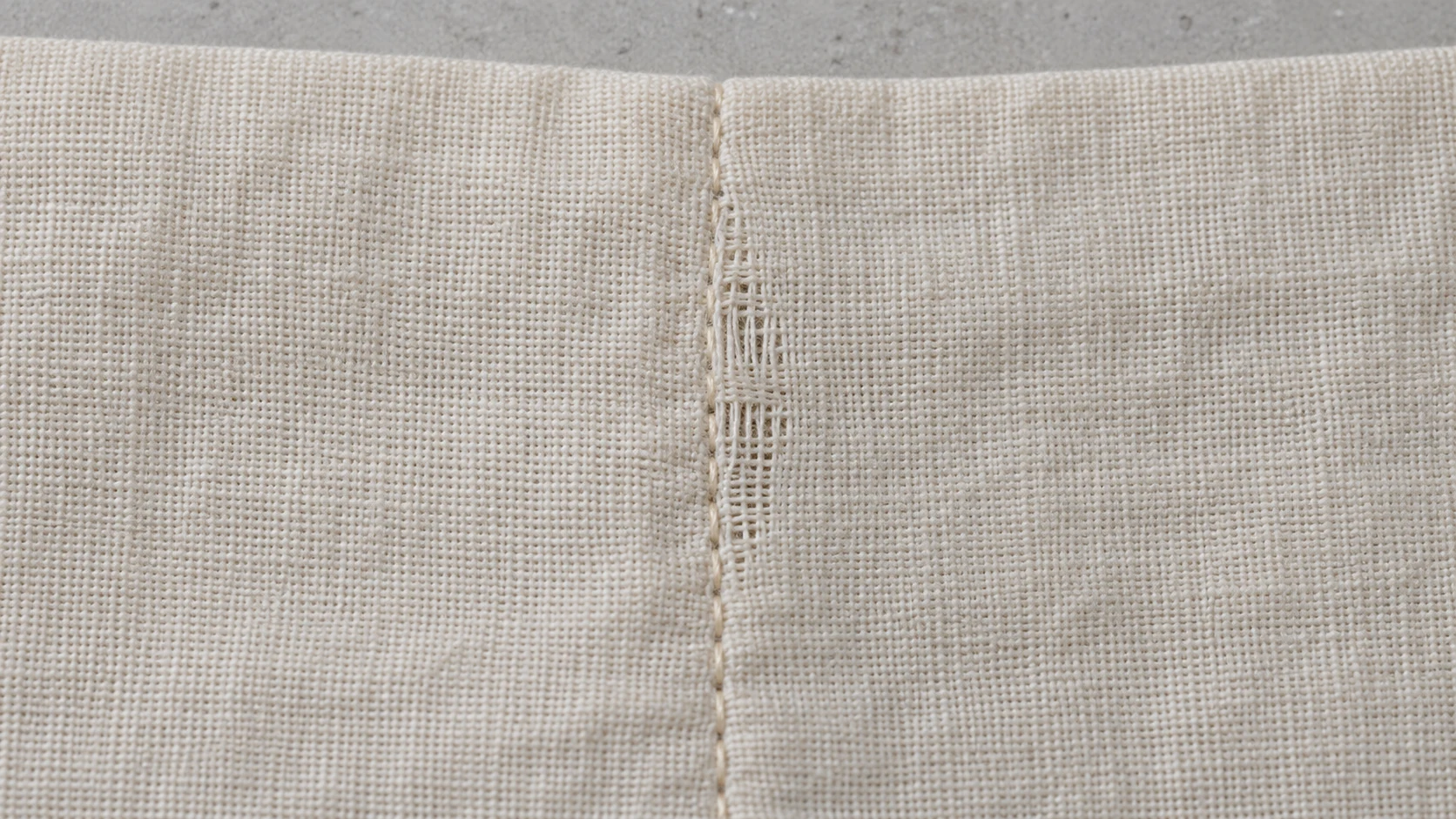
Keep the observation separate from the defect classification and acceptance decision. Its severity depends on the product requirement, location and agreed inspection criteria. Do not assign one universal major-or-minor label to every visible gap.
Map the garment locations before requesting tests
Ask the development team to identify where the design places demand on a sewn join. Depending on the style, that review may include a trouser seat, an armhole, a fitted shirt side seam or a pocket attachment. These are review candidates, not a claim that every such seam will fail.
Mark the locations on the garment tech pack. Include the fabric orientation, seam construction, intended fit and relevant movement. A tight area on a fit sample needs a pattern and fit review as well as investigation of the material. Changing the sewing without addressing an unintended fit restriction may leave the product decision unresolved.
Submit production-intent fabric for the proposed test, with enough material for the laboratory’s preparation requirements. Ask whether the request is a standardized fabric assessment, a trial using the proposed seam construction, or both. Those records answer related questions, but should not be treated as interchangeable evidence.
Read the test method and units before the pass statement
ISO identifies ISO 13936-1:2004 as the fixed seam opening method and ISO 13936-2:2004 as the fixed load method for slippage resistance at a sewn seam in woven fabrics. The public scope of Part 2 includes stretch woven fabrics. Have the laboratory confirm the applicable part and edition for the actual material rather than requesting “ISO 13936” without further detail.
A force associated with a stated opening and an opening associated with a stated load are different report questions. Read the result label, units and conditions together. If the report gives a force, ask what opening it refers to. If it gives an opening, ask what load and assessment procedure produced it. Do not compare two bare numbers because both appear under “seam slippage.”
- Confirm the full method, edition and any declared deviations.
- Identify the test result being reported, with units and the relevant opening or load basis.
- Check the agreed acceptance limit and how the laboratory applies the decision rule.
- Read any failure-mode note, including whether another failure prevented the intended result from being obtained.
An unqualified “pass” leaves these questions unanswered. There is no single buyer-defined load or opening limit that suits every woven shirt, trouser and lining. Agree the requirement around the intended product with the supplier and laboratory; a method reference is not itself a purchase acceptance limit.
Connect direction, fabric state and sample identity
Ask the laboratory to explain its warp and weft labels using a sketch if necessary. Identify both the direction of pulling and the yarn system being assessed. Connect that orientation to the garment panel and seam. A result without a clear direction should not silently become approval for every join in the style.
Check the fabric article, lot, color, finish and sample source. A development swatch and production fabric need traceable identities, even if they look similar. If care is part of the requirement, state the laundering and assessment condition before testing. Keep results before and after care distinguishable rather than combining them into one unexplained pass statement.
Link the report to the relevant fabric entry in the bill of materials. Note whether the specimen seam follows the test method’s preparation or the garment’s proposed construction. A standard specimen report should not be described as a test of the complete garment when it was not one.
Trial a correction without losing the rest of the specification
Coats lists seam allowance, seam type and reinforcement among possible responses to slippage, with stitch-density changes depending on the fabric. Treat these as trial options, not guaranteed fixes. Ask the supplier to propose a specific change on the intended material and explain which observation or result it is meant to improve.
Keep the baseline sample and change one defined factor when practical. Document the revised allowance, stitch, reinforcement or material in the trial record. Review the outside appearance and inside feel as well as the targeted result. A solution that changes bulk, stiffness or visible stitching needs buyer approval for those effects too.
Check for seam puckering and other new appearance problems after a construction change. If the proposed response is a different fabric, reopen material and costing decisions rather than treating it as a sewing adjustment. Ask for the updated consumption and operation basis instead of assuming every correction has the same commercial impact.
Release seam slippage requirements with two linked records
Retain the fabric assessment and the finished-seam or garment approval as separately identifiable records. The first should identify the tested material, method, conditions and results. The second should identify the accepted construction, fit review, care condition and any location-specific exceptions. Link both to the same current specification revision.
Use the approved production-reference sample to show what was accepted. Reopen the affected review if the fabric, finishing, seam allowance, stitch arrangement or reinforcement changes. A passing earlier report is useful context, but it does not automatically release a substituted material or revised seam.
To discuss seam slippage in woven apparel with Yinuo Apparel, send the tech pack, fabric specification, intended fit, seam-location map and available reports. Include clear sample photographs, the report’s units and limits, and any proposed correction so the next trial can resolve a defined material or construction question before bulk release.